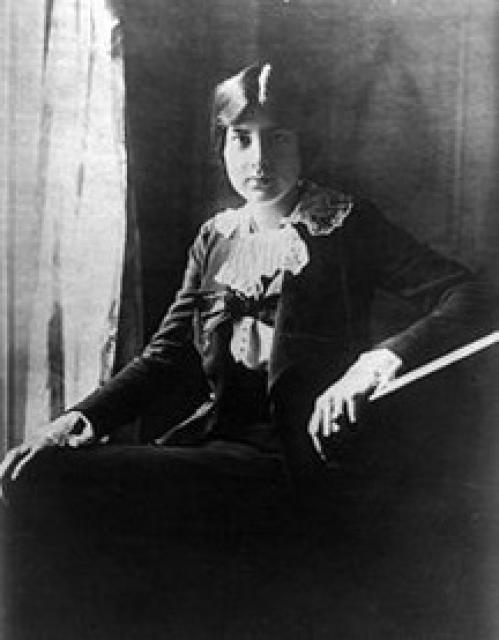
Lili Boulanger
 France
Biography of Lili Boulanger
Lili Boulanger, a French composer, was born into a musical family as the younger sister of Nadia Boulanger. Her father was a composer and vocal teacher at the Paris Conservatory, while her mother was a singer named Raisa Myshetskaya from St. Petersburg. Lili learned to read music notes at the age of six, even before learning the alphabet. Her first piano lessons were given by a family friend, Gabriel Fauré.
Due to her fragile health, Lili was homeschooled. Only one of her early compositions, a Waltz in E-flat major (1906), has survived. In 1909, she entered the Paris Conservatory. In 1913, she became the first woman to receive the prestigious Prix de Rome for her cantata "Faust et Hélène". The premiere of her composition in November of the same year at the Théâtre Chatelet was a great success, and she was welcomed at the Élysée Palace by the President of France, Raymond Poincaré.
In 1914, as a laureate of the Prix de Rome, she spent four months at the Villa Medici in Rome, but her trip was cut short by the outbreak of World War I. Unfortunately, Lili passed away prematurely from tuberculosis and was buried at the Montmartre Cemetery.
Lili Boulanger was the author of instrumental, vocal, and choral compositions, as well as religious music. She set the poetry of Mussorgsky, Maeterlinck, Leconte de Lisle, A. Samain, and F. Jammes to music. She left an unfinished opera, "Princess Maleine", based on Maeterlinck's play of the same name.
Today, Lili Boulanger's works are recorded by conductors such as Nadia Boulanger, John Eliot Gardiner, Igor Markevitch, and others. They are performed by renowned artists and ensembles such as the La Mure Orchestra, Monteverdi Choir, BBC Philharmonic Orchestra, and the London Philharmonic Orchestra under the baton of John Eliot Gardiner. The Lili Boulanger Prize has been established, and an asteroid, 1181 Lilith, is named after the composer.



