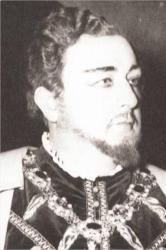
Louis Quilico
 Canada
- Biography of Louis Quilico
- Early Life and Education
- Professional Career
- Teaching Career and Personal Life
Biography of Louis Quilico
Louis Quilico, a Canadian opera singer, was a Companion of the Order of Canada (CC). He was one of the leading dramatic baritones of his time and was known for his exceptional performances of works by great Italian and French composers, especially Giuseppe Verdi. Often referred to as "Mister Rigoletto" after Verdi's opera, Quilico spent 45 years performing alongside the greatest opera stars and spent 25 years at the Metropolitan Opera in New York City. After retiring from the stage in 1998, he continued to perform and record, frequently collaborating with his second wife, pianist Christina Petrowska-Quilico. They released four CDs together and toured extensively until Quilico's passing.
Early Life and Education
Louis Quilico was born on January 14, 1925, in Montreal, Quebec. His father was of Italian descent, and his mother had Franco-Canadian roots. In his childhood and youth, he studied singing with Frank H. Rowe in his hometown of Montreal and was a soloist in a church choir. After winning a competition in 1947, he continued his vocal training in Italy at the National Academy of Santa Cecilia in Rome under the guidance of Teresa Pediconi and baritone Riccardo Stracciari. He also studied at Mannes College the New School for Music in New York City and the Conservatoire de musique du Québec à Montréal under Martial Singher's leadership.
Professional Career
Quilico made his professional debut in 1954 as Rangoni in Boris Godunov in Montreal. In 1955, he won the annual Metropolitan Opera Auditions and made his debut at the New York City Opera as Germont in La traviata on October 10 of the same year. In 1970, he performed Nottingham in Tito Capobianco's production of Roberto Devereux with Beverly Sills and Plácido Domingo.
Internationally, Quilico made his debut in 1959 at the Spoleto Festival in Italy, singing the lead role in Donizetti's Il Duca d'Alba. He first performed at Covent Garden in London in 1960 in La traviata and remained a member of the company until 1963. In 1962, he made his debut as Rigoletto at the Bolshoi Theatre in Moscow, and a year later, he debuted at the Paris Opéra as Rodrigue in Don Carlos. In 1966, he participated in the world premiere of Darius Milhaud's La Mère coupable in Geneva. Quilico also regularly performed at the Vienna State Opera and Teatro Colón in Buenos Aires.
In Canada, Quilico performed with the Canadian Opera Company in Toronto, making his debut as Iago in Otello in 1960. He portrayed roles such as Rigoletto, Macbeth, Simon Boccanegra, Germont, Amonasro in Aida, Scarpia in Tosca, Enrico in Lucia di Lammermoor, and many others. His final performance as Rigoletto was at the Opéra de Montréal in 1991.
During the 1970s, Quilico performed in major opera houses throughout the United States, singing roles in operas such as Luisa Miller in San Francisco, I puritani in Philadelphia, Manon in New Orleans, and Tosca in Baltimore. He also participated in concert versions of rare operas with the American Opera Company, primarily at Carnegie Hall. Quilico's official debut at the Metropolitan Opera took place on January 1, 1973.
Teaching Career and Personal Life
In addition to his performing career, Quilico taught at the University of Toronto from 1970 to 1987, McGill University in Montreal from 1987 to 1990, and the Philadelphia Academy of Vocal Arts from 1995 to 2000.
Quilico had two children, a daughter and a son named Gino Quilico, who also became a baritone opera singer, from his first marriage to Lina Pizzolongo. Lina passed away in 1991. Quilico married for the second time on November 30, 1993, to Christina Petrowska. He passed away on July 15, 2000, in Toronto due to complications following knee surgery.