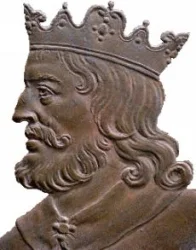
Louis the Child
Louis the Child inherited a kingdom before he was old enough to rule it. Born in 893, he became king of East Francia in 899 after the death of his father, Arnulf of Carinthia. His short reign was marked by Magyar raids, powerful regional nobles, and the fading of Carolingian authority in the east. When he died in 911, the East Frankish Carolingian line ended with him.
A Royal Childhood
Louis was the only legitimate son of Arnulf and his wife, Ota. His father had risen to power in the turbulent politics of the Carolingian world and secured the East Frankish throne in 887. Louis’s birth offered a dynastic hope, but Arnulf’s health deteriorated, and the boy was still very young when his father died in December 899.
A succession council at Forchheim recognized Louis as king. He was crowned on February 4, 900, while still a child. The nickname “the Child” reflects his age at accession, not a personal trait preserved in detail by the sources. As he could not govern independently, leading churchmen and nobles exercised much of the day-to-day authority around him. Archbishop Hatto of Mainz became one of the most influential figures at court, while the Conradine family grew in political importance.
A Kingdom Under Pressure
Louis ruled during a period when royal power depended heavily on cooperation with regional leaders. East Francia was not a centralized state in the modern sense: dukes and other magnates held substantial authority in their territories, and the king’s ability to mobilize them mattered as much as formal titles.
The kingdom also faced repeated attacks from the Magyars, who were expanding their influence in central Europe. Louis was recognized as ruler of Lotharingia after the death of his half-brother Zwentibold in 900, extending his claim westward, but the title did not remove the difficulties of maintaining control across a fractured realm.
In 903, royal authorities issued the Raffelstetten customs regulations, setting out rules for trade and toll collection along the Danube frontier. The document offers a rare glimpse of commerce and governance in Louis’s time, even as political histories of the reign are dominated by warfare and instability.
Raids, Defeats, and the End of a Dynasty
The Magyar threat brought a series of painful military setbacks. In 907, an East Frankish and Bavarian force campaigning eastward suffered a crushing defeat at Pressburg. The Bavarian margrave Luitpold and other prominent leaders were killed, weakening the kingdom’s defenses along the frontier.
Louis’s forces suffered another major defeat near Augsburg in 910. The king was described as the nominal leader of the expedition, though the surviving accounts offer little detail about his personal role on the battlefield. The repeated failures exposed the limits of a court led by a young monarch and reliant on divided regional powers. Meanwhile, disputes among nobles continued to erode the crown’s authority.
Louis died in September 911, probably at Frankfurt, though accounts differ on the precise date and location. He left no children. With his death, the East Frankish branch of the Carolingian dynasty came to an end. The leading nobles elected Conrad of Franconia as king, while Lotharingian magnates turned toward the West Frankish ruler Charles the Simple. Louis’s reign was brief, but it fell at a turning point: the East Frankish kingdom survived, while the dynasty that had ruled it did not.