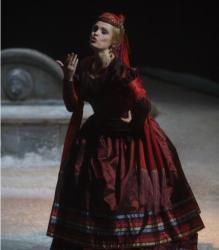
Lucie Weidt
- Luci Weidt, a Renowned Soprano
- Early Life and Training
- Opera Debut
- International Career
- Notable Roles
- Teaching and Legacy
- Contemporary Acclaim
- Recorded Legacy
Luci Weidt, a Renowned Soprano
Luci Weidt, a German soprano, left an indelible mark on the world of opera.
Early Life and Training
Born in Troppau, Weidt began her musical journey in Vienna. She honed her skills under the tutelage of the renowned Rosa Papier-Paumgartner.
Opera Debut
In 1900, Weidt made her operatic debut in Leipzig. Two years later, she captivated audiences in Vienna as Elisabeth in Wagner's "Tannhäuser."
International Career
For the majority of her career, Weidt graced the stage of the Vienna State Opera. However, she also performed in Paris, Milan, Amsterdam, Brussels, Buenos Aires, and New York.
Notable Roles
Weidt excelled in her portrayals of the Marschallin in Strauss's "Der Rosenkavalier" and Kundry in Wagner's "Parsifal." In 1919, she created the role of the Nurse in Strauss's "Die Frau ohne Schatten."
Teaching and Legacy
After retiring from singing, Weidt dedicated her time to teaching in Vienna. She passed away in 1940, leaving behind a legacy as one of Vienna's most acclaimed sopranos.
Contemporary Acclaim
Gustav Mahler was captivated by Weidt's voice, describing it as "enchanting." Despite her talent, she faced misfortune in New York during the 1909-1910 "Golden Age of Opera." Nonetheless, her impact on the operatic world remains significant.
Recorded Legacy
Among Weidt's recorded works, "Harold Wayne Collection Vol. 35" stands as a testament to her exceptional talent. Through her recordings, her voice continues to inspire and delight audiences worldwide.