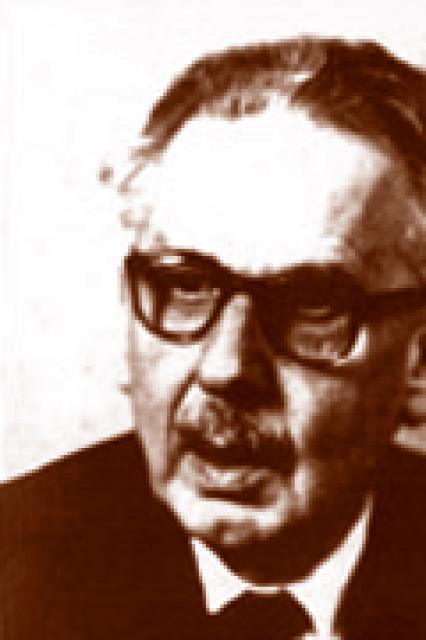
Ludwig Binswanger
 Switzerland
Biography of Ludwig Binswanger
Ludwig Binswanger was a Swiss psychiatrist and the founder of existential psychology. Born on April 13, 1881, in Kroislingen, Switzerland, Binswanger came from a family of doctors. During his time in high school, he read Immanuel Kant's "Critique of Pure Reason," which sparked his philosophical pursuits. Although he found neo-Kantianism too abstract, he was intrigued by its attempt to describe the a priori structures that make human existence possible.
Binswanger received an excellent medical education in Lausanne and Heidelberg. In 1907, he obtained his medical degree from the University of Zurich. With the support of Eugen Bleuler, the famous director of the Bellevue psychiatric hospital in Zurich, Binswanger completed his psychiatric residency.
In the same year, Binswanger was introduced to Sigmund Freud by Carl Gustav Jung. Despite their doctrinal differences, Binswanger and Freud developed a close friendship that lasted until the end of their days. Binswanger was one of the first European psychiatrists to apply psychoanalysis in clinical practice, despite opposition from the medical establishment of the time. In recognition of his significant role in the promotion of psychoanalysis in the early 20th century, Freud recommended Binswanger to participate in the work of the Vienna Psychoanalytic Society. In 1910, Binswanger was elected president of this society. Notable psychoanalysts, such as A. Storch, M. Boss, G. Bally, R. Kuhn, J.H. Van Den Berg, and F.J. Buytendijk, were part of this psychoanalytic movement.
From 1910 to 1920, Binswanger made attempts to reevaluate Freud's teachings and the main problems of psychiatry in the spirit of neo-Kantianism, the psychology of Wilhelm Dilthey and Edmund Husserl's phenomenology. He eventually rejected Freud's biologism and determinism, including his theories of the unconscious, libido, repression, and dream symbolism. In 1911, Binswanger succeeded his father as the director of the Bellevue sanatorium in Kroislingen, a position he held until 1956 when he passed it on to his son.
In 1927, with the publication of Martin Heidegger's "Being and Time," Binswanger believed he had found the final foundation for psychology, a doctrine that could serve as the basis for his own conception of human beings and the reform of psychoanalysis. Binswanger's approach became known as "Dasein analysis" and later became a guiding principle for numerous followers in Western Europe and America. He attempted to apply some of Heidegger's analytic ideas to practical psychiatry, considering the unity of the individual and the world of humanity. Binswanger provided the first formulation of existential analysis as a philosophical foundation for psychoanalytic therapy, asserting that Heidegger's analytics underlie any future anthropology.
Existential analysis, as proposed by Binswanger, is a method of analyzing personality in its entirety and the unique nature of its existence. Binswanger defines existential analysis as a phenomenological analysis of actual human existence, aiming to reconstruct the inner world of experience. According to this method, the authentic being of an individual is revealed by delving into oneself to choose an independent "life plan" unaffected by external factors. When an individual loses the openness to the future characteristic of authentic existence, they begin to feel abandoned, their internal world shrinks, and their potential for development remains beyond the horizon of their vision, leading to neurosis. Binswanger's goal in existential analysis is to help neurotics realize their freedom and capacity for self-determination. He believes that the genuine personal aspect of humans is only revealed when they are freed from causal connections with the material world and the social environment. Mental illnesses are seen as a consequence of the loss of continuous self-formation, representing the extreme absence of authenticity and detachment from free transcendence.
Binswanger's major work, "The Forms and Knowledge of Human Existence," was published in 1942 and primarily had a philosophical character. In this work, Binswanger attempted to supplement Heidegger's existential analysis with the philosophical anthropology of Max Scheler and the ideas of Jewish thinker Martin Buber, as well as the concepts of Russian religious philosopher Semyon Frank.
Binswanger's works gained widespread recognition and influenced a wide range of Western philosophers, psychologists, and psychiatrists. They played a role in the emergence of the anti-psychiatry movement and had a noticeable impact on German philosophy and literary criticism. Binswanger was a member of ten medical academies and received the highest honor for a psychiatrist, the Kraepelin Medal, in 1956.
After more than half a century of work, Binswanger created a philosophical and medical anthropology that continues to serve as the foundation for most versions of existential-phenomenological psychology and psychiatry. He passed away in 1966.


