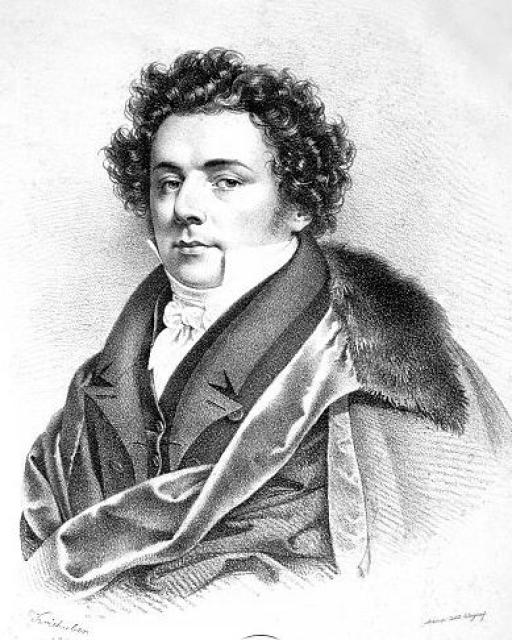
Luigi Lablache
 Italy
Italy- Luigi Lablache: A Colossal Bass-Baritone
- Operatic Debut and Triumph
- Collaboration with Great Composers
- International Acclaim and Legacy
- Russian Triumph
- Retirement and Death
- Notable Operatic Roles
Luigi Lablache: A Colossal Bass-Baritone
Early Life and Musical BeginningsLuigi Lablache was born into a musical family in Naples, Italy. His father, a wealthy French merchant, and his Irish mother nurtured his natural talent for music. From an early age, Lablache excelled on the violin and double bass.
Operatic Debut and Triumph
In 1814, Lablache made his operatic debut in Sicily alongside his wife, Teresa Pinotti. His powerful bass-baritone voice, perfectly matched by his imposing physique, made an immediate impression. In 1821, he triumphed at Milan's Teatro alla Scala in Rossini's "Cinderella," a success that followed him throughout his career.
Collaboration with Great Composers
Lablache's vocal prowess inspired the admiration of many composers. Franz Schubert dedicated three Italian songs to him in 1827. He performed Mozart's "Requiem" at Beethoven's funeral in 1827 and sang it again, alongside Pauline Viardot and Anaïs Castellan, at Chopin's funeral in 1849.
International Acclaim and Legacy
European SuccessLablache captivated audiences across Europe, performing to critical acclaim in Naples, Palermo, Milan, Turin, and Vienna. In 1836-1837, he served as vocal teacher to the future Queen Victoria of England.
Russian Triumph
In 1852, Lablache embarked on a successful tour of Russia, performing at the Imperial Italian Opera in St. Petersburg. His recommendation led to the invitation of another renowned Italian singer, Camillo Everardi.
Retirement and Death
Following his Russian tour, Lablache retired from the operatic stage and returned to his native Naples. He died there on January 23, 1858. Luigi Lablache is remembered as a charismatic performer and a vocal giant, leaving behind a legacy of celebrated operatic roles and a comprehensive vocal method.
Notable Operatic Roles
Geronimo ("The Secret Marriage" by Cimarosa)Oroveso ("Norma" by Bellini)
Wilton ("The Puritans" by Bellini)
Count Moor ("The Robbers" by Verdi)
Figaro ("The Barber of Seville" by Paisiello)
Othello ("Otello" by Verdi)
William Tell ("William Tell" by Rossini)
Moses ("Moses" by Rossini)
Don Pasquale ("Don Pasquale" by Donizetti)
Henry VIII ("Anna Bolena" by Donizetti)
Nemorino ("The Elixir of Love" by Donizetti)
Arsace ("Semiramide" by Rossini)
Fernando Villabella ("The Thieving Magpie" by Rossini)
Vocal Method and Legacy
Lablache's "Method of Singing" (1846) remains a renowned guide for bass singers. His vocal pedagogy emphasized a focus on breath control, phrasing, and artistic interpretation. His contributions to the art of singing have left an enduring mark on the world of opera.