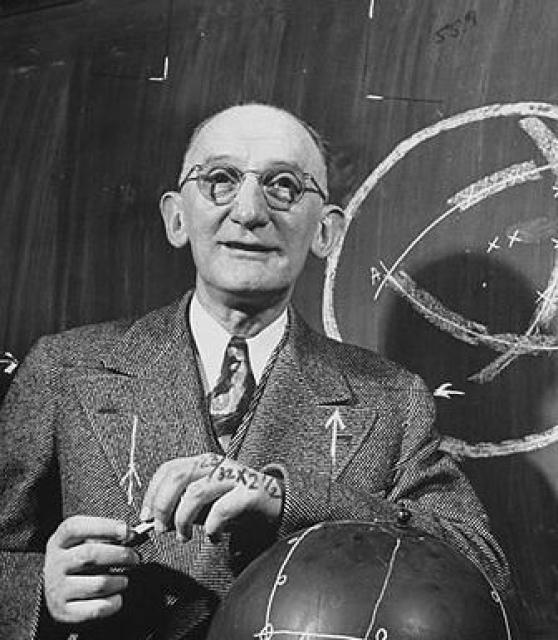
Luis Leon Thurstone
 USA
USABiography of Louis Leon Thurstone
Louis Leon Thurstone (May 29, 1887 - September 29, 1955) was an American psychologist and psychometrician. He is known for his contributions to the field of psychology, particularly in the areas of psychometrics and perception.
Early Life and Education:
Thurstone studied electronics at Cornell University, where he earned a degree in mining engineering in 1912. Afterward, he worked as an assistant to Thomas Edison in his laboratory in East Orange. He then taught descriptive geometry at the University of Minnesota from 1912 to 1914. In 1914, he began studying psychology at Carnegie Institute of Technology, focusing on experimental learning. He served as an assistant, professor of psychology, and dean at the institute from 1915 to 1923.
Career:
In 1923, Thurstone began working as a psychologist and head of the personnel department at the Institute for Management Research in Washington, D.C. He returned to the University of Chicago in 1924 as an associate professor of psychology and became a full professor in 1927. During his time at the university, he established a psychometric laboratory.
Contributions:
Thurstone was one of the founders of the Psychometric Society and the journal "Psychometrica." He served as the publisher of the "American Council on Educational Psychological Examinations" for over 24 years and was a co-editor of the "Journal of Social Psychology." He was the president of the American Psychological Association in 1932 and the president of the Psychometric Society in 1936.
Thurstone was one of the first psychologists to apply mathematical methods in the fields of psychology and sociology. He introduced the concept of Thurstone scaling, a method of measuring attitudes using paired comparisons. He also developed his own variation of multidimensional factor analysis, which challenged Charles Spearman's concept of a general intelligence factor (g-factor).
Thurstone's research focused on various aspects of intelligence and perception. He identified multiple group factors, such as perceptual abilities, spatial abilities, and verbal abilities, as primary traits of intelligence. He also used mathematical methods to study perception and developed scales to measure attitudes and values related to war, religion, censorship, social institutions, customs, races, and nations.
Legacy:
Thurstone's work has had a significant impact on the fields of psychology and psychometrics. His contributions to measurement theory and the study of attitudes and perception have shaped the way researchers analyze and understand human behavior. His mathematical methods continue to be used in various areas of psychology and social sciences.


