Lysimachus
- From Alexander’s court to Thrace
- Building a kingdom
- The last battle of the Successors
- A durable mark on the Hellenistic map
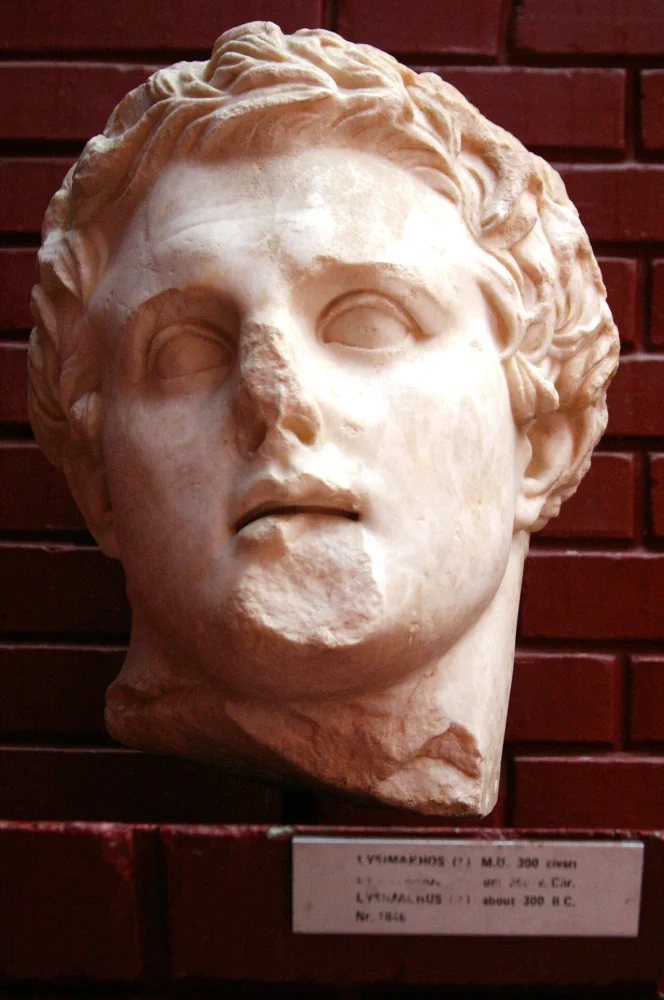
Lysimachus was one of the generals who turned Alexander the Great’s empire into a patchwork of rival kingdoms. A Macedonian officer who survived the first turbulent decades after Alexander’s death, he built a powerful realm around Thrace, expanded into Asia Minor, and eventually took control of Macedonia itself. His long career ended on the battlefield, in the final major clash between Alexander’s successor kings.
From Alexander’s court to Thrace
Born around 355 BCE, Lysimachus came from Pella in Macedonia and became a close associate of Alexander. Ancient accounts place him among the king’s bodyguards, a position that reflected both military standing and proximity to the royal court. He accompanied Alexander’s generation through the conquest of the Persian Empire and witnessed the extraordinary scale of the new dominion.
When Alexander died in 323 BCE without an adult heir, his commanders divided the provinces among themselves. Lysimachus was assigned Thrace, a strategic but difficult region on the empire’s European edge. He spent years securing its borders and defending his authority against both local Thracian rulers and rival Macedonian generals.
Building a kingdom
The wars among the successors brought Lysimachus into changing alliances. In 306 BCE he adopted the royal title, as other former commanders did. His position grew significantly after the Battle of Ipsus in 301 BCE, where his forces joined those of Seleucus, Cassander, and Ptolemy in defeating Antigonus Monophthalmus and his son Demetrius. The victory gave Lysimachus control of much of western Asia Minor.
He later fought Demetrius again, and by 285 BCE he had taken Macedonia. At the height of his power, Lysimachus ruled an extensive territory linking the Balkans and Anatolia. His court used diplomacy, military force, and dynastic marriage to hold together lands with different traditions and competing elites. He founded Lysimacheia on the Gallipoli peninsula as a strategic center and named it after himself.
The last battle of the Successors
Lysimachus’s final years were marked by renewed conflict with Seleucus, who had emerged as the strongest of the successor kings in Asia. In 281 BCE, the two armies met at Corupedium in western Asia Minor. Lysimachus was defeated and killed, likely in his mid-seventies. His death closed the era of the original Diadochi, the commanders who had fought over Alexander’s legacy.
His empire quickly fragmented. Seleucus briefly took control of much of Lysimachus’s territory, but he too was assassinated soon afterward, and Macedonia again became a contested prize.
A durable mark on the Hellenistic map
Lysimachus did not found a lasting dynasty on the scale of the Seleucids or Ptolemies, but his decades-long rule helped shape the political map of the early Hellenistic world. Thrace became a major base of power, and his campaigns connected European and Asian territories at a time when borders remained fluid. His story is one of endurance and ambition: a trusted officer of Alexander who outlasted rivals, built a kingdom, and fell in the final generation of the successor wars.