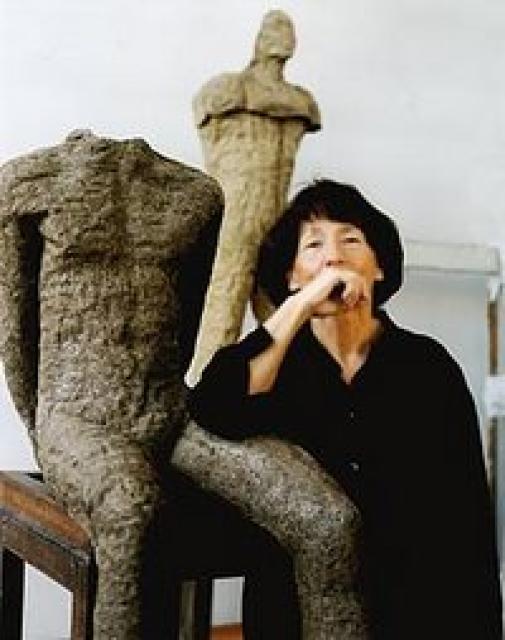
Magdalena Abakanowicz
 Poland
- Magadalena Abakanowicz: Polish Artist and Pioneer of Fiber Art
- Early Career and Textiles
- Three-Dimensional Tapestries
- The "Abakan" Series
- Exploring the Human Condition
- Sculptures and Monumental Installations
Magadalena Abakanowicz: Polish Artist and Pioneer of Fiber Art
Magadalena Abakanowicz, a renowned Polish artist, graduated from the Warsaw Academy of Fine Arts in 1955. Her groundbreaking work revolutionized the art of tapestry, breaking free from traditional boundaries.
Early Career and Textiles
Throughout her early career, Abakanowicz explored the relationship between her abstract textile compositions and the surrounding architectural environment. In the early 1970s, she began experimenting with monochromatic materials, creating works that exploited the interplay of texture and relief. A notable technique involved combining lustrous horsehair with matte wool fibers.
Three-Dimensional Tapestries
Abakanowicz's work evolved into three-dimensional tapestries that often filled the exhibition space. "Improvisation Cord," "Situation," and "Cord, Its Penetration and Disposition in Space" exemplify her efforts to connect abstract constructs with the fourth dimension of time. These works allowed viewers to interact with the installations, moving, playing, and altering them.
The "Abakan" Series
In the late 1960s, Abakanowicz gained international recognition for her "Abakan" series. These large-scale tapestries used coarse materials like old boat ropes to create dramatic, sculptural forms that imitated the surfaces of earth or the human body. Anthropomorphic imagery became a central theme in her work.
Exploring the Human Condition
Abakanowicz delved into the connection between humans and the organic world, exploring birth, growth, decay, and mortality in contrast to the technological advances of modern civilization. Her "Alteration" series was described by philosopher S. Morawski as evoking a sense of "gloomy alienation."
Sculptures and Monumental Installations
Abakanowicz also created semi-abstract and figurative sculptures in bronze. These works, such as "Human Backs" (1976-80), "Embryology" (1980), and "Androgynes" (1985), stand as imposing monuments in cities across the United States and Europe.




