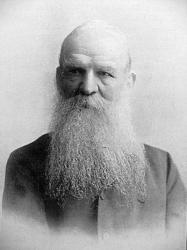
Maksim Geppener
 Germany
- Maxim Hepner: An Architect of German Origin
- Early Life and Education
- Career
- Notable Works
- Collaboration with Ivanov-Shitsa
- Later Years and Legacy
Maxim Hepner: An Architect of German Origin
Maxim Karlovich (Wilhelm-Edward Max) Hepner or Hepner (1848-1924) was a Russian architect of German origin. He worked in Moscow on various municipal projects and served as the chief architect of the city's communal services during their construction under N. A. Alexeev. He was a teacher and later a co-author of I. A. Ivanov-Shitsa.
Early Life and Education
Maxim Hepner was born in Germany and studied at the Polytechnic Institute in Karlsruhe. He worked on the construction of public buildings in Baden before moving to Moscow.
Career
In 1870, Hepner was hired as an assistant to Moscow architect A. S. Kaminsky. The following year, he received the title of a class artist from the Imperial Academy of Arts. From 1873 until the end of his career, he worked on municipal projects in Moscow. He was a member of the Technical Council of the Moscow City Administration from 1873 to 1914.
Hepner held various positions throughout his career, including chief architect of the Educational Home in 1876, chief architect of the Nikolaev Shelter from 1879 to 1893, chief architect of city gymnasiums from 1887 to 1914, and chairman of the Moscow Architectural Society from 1905 to 1906.
Notable Works
Maxim Hepner is known for his construction of numerous schools, including the building of the Railway Engineering School (MIIT) on Obraztsova Street. His most significant works are associated with the reconstruction of communal utilities and the tram network in Moscow during the 1880s and 1890s. Some of his preserved works include the Sokolnicheskaya Police Station with a belfry in 1884, the Gas Plant and Gas Holders near the Kursk Railway Station in 1893, the Pumping Station near the Novospassky Bridge (Water Museum) in 1895, and the Shelter at the corner of Bolshoy Kharitonievsky and Malyy Kozlovsky Lanes in 1895. He also designed tram substations on Krasnoprudnaya Street and in Sokolniki in the early 1900s.
Collaboration with Ivanov-Shitsa
In the early 1890s, a young I. A. Ivanov-Shitsa trained under Hepner. They collaborated on the construction of the Khomyakov House on Kuznetsky Most and participated in various architectural competitions in 1914.
Later Years and Legacy
In the 1900s, Hepner shifted his focus from practical construction to administration. After 1914, he retired from active work. He was buried at the Vagankovo Cemetery.