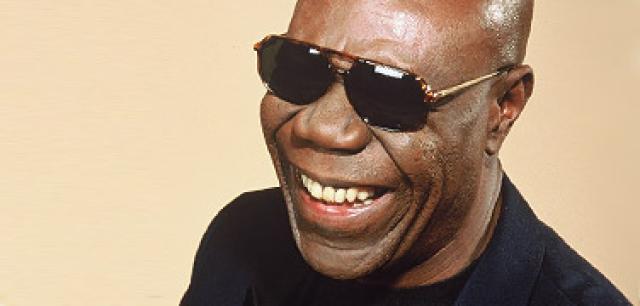
Manu Dibango
 Cameroon
Biography of Manu Dibango
Manu Dibango is a saxophonist, composer, singer, pianist, and arranger, and is one of Cameroon's musical superstars. In his heart, he is a jazz musician, but he also introduces listeners from around the world to the style of Makossa (and other West African styles), collaborating with musicians from Johnny Pacheco to Fela Kuti, Fania All-Stars, and Don Cherry. He is truly international in his vision - he completed college in France in 1949 and has since lived in Brussels, Paris, Kinshasa, and Côte d'Ivoire for extended periods of time.
When Manu Dibango came to Europe as a student, he could have chosen to continue his studies and return to Cameroon with a diploma, leading a narrow life. However, his exceptional musical talent and growing love for jazz soon led the young Manu down a path full of musical adventures. Paris, with jazz permeating every corner and alley, became the perfect place for Manu to blend, listen, and learn. He became acquainted with the music of Armstrong, Ellington, Young, and Parker, as well as the multifaceted life of the Parisian jazz scene. His first stop in the French capital was relatively short. In the early years, Manu Dibango was influenced by jazz, particularly the jazz that resonated from the stage of a jazz club in Brussels in the early 1950s.
He continued his career in his homeland of Congo (Zaire) in the early 1960s, playing with the legendary Kabasele and leading an ensemble called African Soul. It was a time of the birth of African states, with a fierce struggle for independence or more or less peaceful coexistence, but words like "independence" and "Afrocentrism" became commonplace. The great Kabasele invited Manu to join his new orchestra called "African Jazz" to play Congolese music. Manu accepted the invitation and returned to Africa. His love for jazz on one hand, and traditional African music on the other, prompted Manu to experiment, combining different styles of music to create his own sound. With his curiosity and sensitivity, Manu has always been interested in diverse styles of music, incorporating jazz, reggae, rap, and many others to create a rich effect.
In 1972, Manu scored his first hit that gained international recognition - "Soul Makossa," which was particularly well received in the United States. This contributed to a significant increase in knowledge about African music and the breakdown of some dominant musical prejudices. Manu found hidden pleasure in going against the structure of established musical ideas and traditionalism. His goal was and still is to build bridges between continents. In 1973, with the release of the album "Soul Makossa," his name rose to the level of the most famous musicians in Africa. The song "Mouvement Ewondo," recorded on the B-side of the record, was a "prayer" for the Cameroonian football team. It was picked up by a New York radio station and became a hit worldwide. Simultaneously, nine different versions of it appeared on the "Billboard" charts. This rhythm was even adopted by Michael Jackson in the album "Thriller."
Upon returning home, Soul Makossa became the foundation for a new generation of musicians who combined tradition with the latest achievements in sound recording. However, the audience always seemed to have a conflicting attitude towards Manu Dibango. They respect and admire his international recognition, but his music is rarely played in clubs and on dance floors. Soul Makossa itself was a rather atypical piece in the Makossa style. In the early 1980s, Manu paid homage to Cameroon by recording, arranging, and presenting a set of three albums called "Fleurs musicales du Cameroun" ("Musical Flowers of Cameroon"). This collection brings together the best Cameroonian performers, veterans, and new names in pop music, as well as lesser-known traditional performers. The albums include a wide variety of rhythms that brought life to styles such as pop-makossa, mangambe, assiko, and bikutsi in the 1980s and 1990s.
Manu was a pioneer in establishing relations between the music of French-speaking Africa and Paris. He has recorded and released over 20 albums. Currently, he also tours the world, spending significant time supporting and inspiring young musicians and advocating for humanitarian causes. Is it time for him to retire? Absolutely not. Crossing the threshold of his 60s, Manu is too young to live only in memory.


