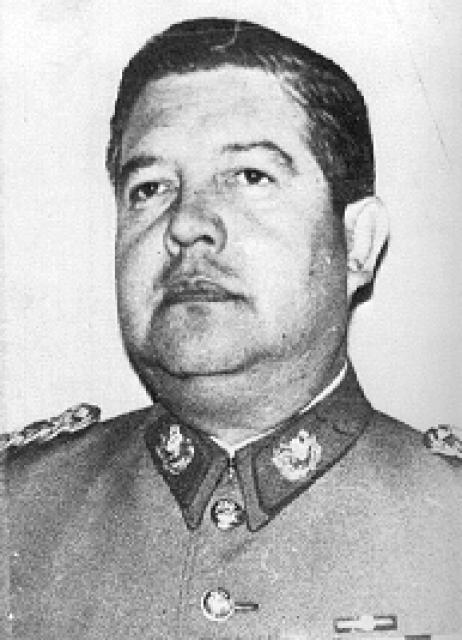
Manuel Contreras
 Chile
Juan Manuel Guillermo Contreras Sepúlveda, known as Manuel Contreras, was a Chilean Army officer who headed the National Intelligence Directorate (DINA), the secret police of Augusto Pinochet’s dictatorship, from 1973 to 1977. Under his leadership, DINA became a central instrument of state repression, carrying out political surveillance, detention, torture, forced disappearance and assassination. After Chile returned to civilian rule, Contreras was convicted in numerous human-rights cases and died while serving prison sentences.
Early life and military career
Contreras was born in Santiago, Chile, on May 4, 1929. He entered the Bernardo O’Higgins Military School in 1944 and graduated as an Army officer in 1947. Trained as an engineer, he later served as an instructor at the Army’s School of Military Engineers in Tejas Verdes and held several posts in the armed forces.
Following the September 11, 1973 military coup that overthrew President Salvador Allende, Contreras was appointed to organize and lead a new national intelligence service. DINA was initially created by the military junta and formally established by decree in 1974. Reporting directly to Pinochet, it developed into a powerful security organization that operated inside Chile and abroad.
DINA and repression
From 1973 until its dissolution in 1977, DINA pursued people regarded as opponents of the dictatorship, including members and supporters of left-wing political movements. Its agents carried out clandestine arrests and held detainees at secret sites where people were tortured. Many victims were killed or forcibly disappeared; families were often left without information about their fate. As director, Contreras oversaw the organization during this campaign of systematic repression.
DINA also worked with security services of other South American dictatorships through Operation Condor, a cross-border network that targeted political exiles and dissidents. Its agents conducted operations outside Chile, including the 1976 car-bomb assassination in Washington, D.C., of former Chilean foreign minister Orlando Letelier and his colleague Ronni Moffitt. DINA operatives were also responsible for the 1974 assassination of former Army commander Carlos Prats and his wife, Sofía Cuthbert, in Buenos Aires.
Contreras left the DINA directorship when the agency was replaced by the National Information Center in 1977. He was called to retirement from the Army in 1978. The end of DINA did not end political repression in Chile, but the agency’s record became a major focus of later investigations into dictatorship-era crimes.
Trials and death
After Chile’s return to democracy, courts prosecuted Contreras for crimes committed by DINA. In 1995, he was convicted for his role in the assassination of Letelier and sentenced to seven years in prison. Subsequent cases resulted in additional convictions for kidnapping, forced disappearance and murder, including crimes involving victims in Chile and abroad.
At the time of his death, the accumulated prison sentences against him totaled 529 years. Contreras died on August 7, 2015, at age 86, while imprisoned at Punta Peuco, a facility for people convicted of human-rights abuses under the dictatorship.
Historical significance
Contreras remains a central figure in the history of Chile’s military dictatorship because of his command of DINA and the agency’s role in organized state violence. His convictions marked part of the legal process by which Chile sought accountability for forced disappearances, torture and political killings. The cases against him also documented how the dictatorship’s intelligence apparatus operated across national borders and left lasting harm for victims’ families and Chilean society.