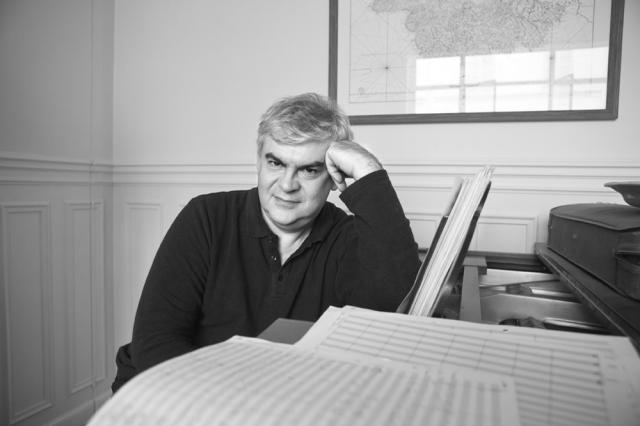
Marc-Olivier Dupin
 France
- Musical Training
- A Composer Across Forms
- Leadership in Music and Education
- Recognition and Continuing Work
Marc-Olivier Dupin has spent his career moving between composition, conducting and the leadership of French music institutions. Trained as a violinist and composer, he has written for theatre, opera, ballet, film and young audiences. At the same time, he has helped shape music education and broadcasting, leading the Paris Conservatoire, the Orchestre national d’Île-de-France and France Musique at different stages of his career.
Musical Training
Born in Paris in 1954, Dupin began studying violin as a child with his father, a violin teacher. He continued his studies with Nicole Cochereau before entering the Conservatoire national supérieur de musique et de danse de Paris. There he earned distinctions in viola, harmony, counterpoint, fugue, analysis, orchestration and conducting.
As a student, he encountered actors, directors and filmmakers, and started composing for projects that combined music with theatre and visual storytelling. That early interest in working across forms would remain central to his musical voice. Rather than confining himself to the concert hall, he pursued work shaped by text, image, movement and performance.
A Composer Across Forms
Dupin has written music for stage plays, short films, documentaries, opera and ballet. He worked extensively with director Brigitte Jaques on both classical and contemporary theatre, including plays by Corneille and Racine. His collaborations with director and librettist Ivan Grinberg led to operas for the Opéra-Comique, including Robert le cochon et les kidnappeurs and Le Mystère de l’écureuil bleu.
His ballet score Les Enfants du Paradis was created for the Paris Opera in 2008. He has also composed musical tales for children, including Le Petit Prince, based on the story by Antoine de Saint-Exupéry and illustrations by Joann Sfar. These works show how often Dupin writes for audiences encountering music through narrative, theatre or dance.
For more than a decade he has collaborated with documentary filmmaker Jérôme Prieur, composing scores for a series of historical films. He has also arranged music for performers and festivals, and in 2004 established the publishing house Tsipka Dripka to issue his works. His output is varied in scale and setting, but remains grounded in the practical demands of performance and the interplay between music and other art forms.
Leadership in Music and Education
Alongside composing, Dupin has held a succession of institutional roles. From 1993 to 2000, he directed the Conservatoire national supérieur de musique et de danse de Paris, where he worked to support the development of its teaching programs. He also served as secretary-general of the European Association of Conservatoires and later led the Cefedem d’Aquitaine.
In the early 2000s, he advised France’s education minister Jack Lang on artistic education and cultural action. He then became director-general of the Orchestre national d’Île-de-France, serving from 2002 to 2008. His work moved into broadcasting when he became director of France Musique in 2008 and director of music at Radio France from 2008 to 2011. He later advised the National Centre for Cinema on music for film and, from 2013 to 2016, led the Pôle Sup’93 and the Cefedem d’Île-de-France.
Recognition and Continuing Work
Dupin’s contributions have been recognized with national honors, including the Ordre national du Mérite, the Légion d’honneur and the Order of Arts and Letters. He has continued to compose and conduct, returning regularly to collaborations with orchestras, opera companies and theatre artists.
His career reflects a broad idea of what a composer can do: create new scores, arrange and interpret existing music, teach, and take responsibility for the institutions that support musical life. By combining artistic work with public service, Dupin has helped connect professional music-making with education, broadcasting and performance for audiences of different ages.