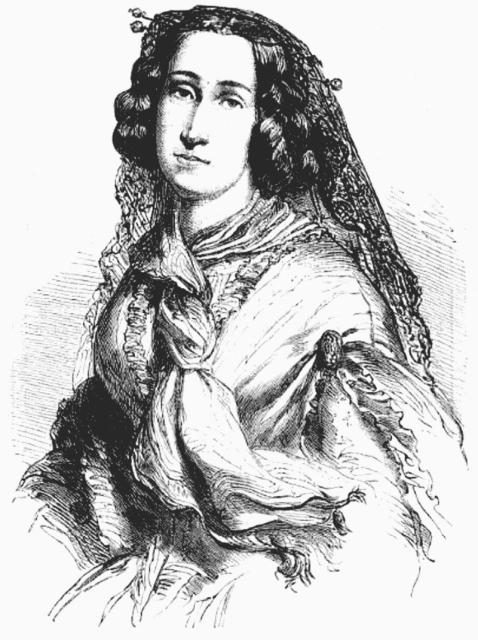
Marceline Desbordes-Valmore
 France
- Marceline Desbordes-Valmore: A French Romantic Icon
- Literary Debut and Marriage
- Literary Legacy
- Musical and Cultural Impact
- Russian Connections
Marceline Desbordes-Valmore: A French Romantic Icon
Early Life and CareerMarceline Desbordes-Valmore was born in Douai, France, in 1786. Her father was an artist and herbologist who lost his fortune during the French Revolution. In 1801, she and her mother embarked on a journey to Guadeloupe, where Marceline made her stage debut as an actress. However, tragedy struck when her mother died from yellow fever in 1802.
Upon her return to France, Marceline continued her acting career in various theaters, performing roles such as Rosina in Beaumarchais's "The Barber of Seville." She encountered renowned actors such as Talma, Marie Dorval, and Mademoiselle Mars. Her personal life was marked by the loss of her five-year-old son, whom she immortalized in her poetry under the name "Olivier."
Literary Debut and Marriage
In 1819, Marceline published her first collection of poetry, "Élégies et romances," which received critical acclaim. In 1817, she married actor Prosper Lanchantin (stage name Valmore) and had three children. She retired from the stage in 1823.
King Louis-Philippe granted her a royal stipend, and she received several prestigious awards for her literary contributions. She was buried in the Montmartre cemetery in 1859.
Literary Legacy
Beyond her lyrical poetry, Desbordes-Valmore also wrote novels, short stories, and children's tales. She captivated the attention of literary giants such as Balzac, Sainte-Beuve, and Baudelaire. Her work significantly influenced Verlaine, Rimbaud, and later French female poets like Anna de Noailles. Verlaine included her among his "poètes maudits" and wrote an essay honoring her. Her books found a place in Nietzsche's library, and Stefan Zweig penned an essay on her life. Louis Aragon dedicated an article to her prose.
Musical and Cultural Impact
Numerous composers of the 19th and early 20th centuries set Desbordes-Valmore's poetry to music, including Marie Malibran, Bizet, Sylvio Franck, and Reynaldo Hahn. Contemporary French singers like Julien Clerc, Benjamin Biolay, and Pascal Obispo continue to perform songs based on her verses. In 1993, the Desbordes-Valmore Association was founded in Douai. Her manuscripts are preserved in the library of her hometown. A street in the 16th arrondissement of Paris bears her name.
Russian Connections
Two volumes of Desbordes-Valmore's poetry were found in Pushkin's library. Notably, scholars have suggested that one of her elegies may have inspired the letter from Tatiana to Onegin in Pushkin's masterpiece. Lermontov admired her novel "L'Atelier d'un peintre" and gave an annotated copy to his friend. Countess Eudokia Rostopchina's poem "Kogda b on znal" is considered an imitation of Desbordes-Valmore.



