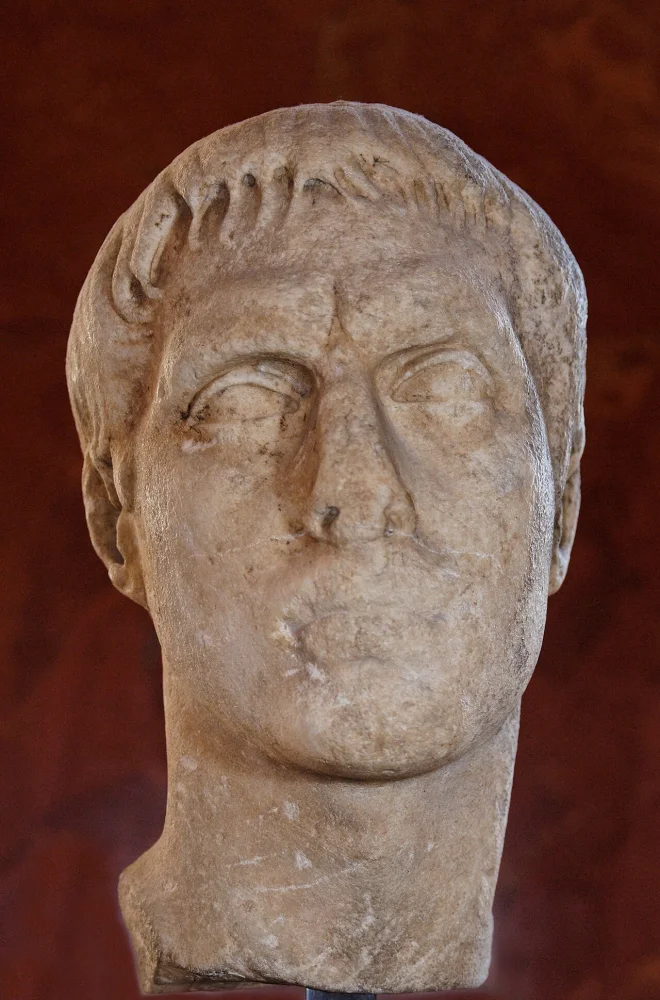
Marcellus
Marcus Claudius Marcellus was born into the family at the center of Rome’s new imperial order. As the nephew of Augustus and husband of the emperor’s daughter, Julia, he seemed positioned for a major political future. His death at just twenty years old cut short a rapid rise and left his name attached to one of the great succession questions of the Augustan age.
A member of Augustus’s family
Marcellus was born in 42 BCE, the son of Gaius Claudius Marcellus and Octavia, the sister of Octavian, later known as Augustus. His mother was a respected political figure who later married Mark Antony, making Marcellus part of a family network that linked Rome’s most powerful leaders.
Following Octavian’s victory in the civil wars, Marcellus received honors that marked his position in the new regime. In 25 BCE, he married Julia, Augustus’s only daughter. The match strengthened the dynastic ties between the emperor and his nephew. Marcellus also served under Augustus in Spain and was appointed curule aedile in 23 BCE, an important magistracy normally held by older men.
A possible heir
Ancient sources and later historians have often seen Marcellus as Augustus’s intended successor. His close family connection, marriage to Julia and unusually rapid political advancement support that interpretation, though Augustus never formally named an heir in the later sense of the word. His position also intersected with the influence of Marcus Agrippa, Augustus’s trusted general and son-in-law through a later marriage to Julia.
The succession question became urgent when Augustus fell seriously ill in 23 BCE. Marcellus received prominent public honors, but Augustus gave his signet ring and papers to Agrippa, showing that the future remained unsettled. Any expectation that Marcellus would eventually inherit power ended when he died later that year at Baiae, near Naples. He was around twenty years old.
A death remembered in poetry
Marcellus’s death deeply affected his mother and the imperial household. The poet Virgil memorialized him in Book VI of the Aeneid, where the future glory of Rome gives way to a poignant passage about the young man who would never fulfill his promise. The lines turned a political loss into one of the poem’s most moving reflections on mortality and unrealized potential.
Augustus also honored his nephew’s memory by completing and dedicating the Theatre of Marcellus in Rome. The structure survived as a major landmark, ensuring that Marcellus’s name remained visible in the city long after his death.
Marcellus left no political record of long service or independent achievement. His historical importance comes from what his brief life represented: the personal and political uncertainty surrounding succession in Augustus’s new regime. His story is a glimpse of how dynastic hopes could gather around one young man, then vanish suddenly with his death.