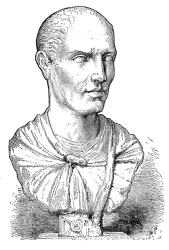
Marcus Furius Camillus
- A Roman Patrician and Soldier
- The Siege of Veii
- Exile and the Gallic Sack
- The “Second Founder of Rome”
- Tradition, Character and Legacy
Marcus Furius Camillus became one of Rome’s great republican heroes: the conqueror of Veii, the general said to have driven out the Gauls, and the “second founder” who persuaded the Romans to rebuild their city. His reputation was already powerful in antiquity, but the surviving accounts were written long after his lifetime and shaped by legend as well as history. What emerges is a figure through whom Romans told stories about leadership, civic duty and the survival of their state.
A Roman Patrician and Soldier
Camillus was born around 446 BCE into the patrician Furia family. His career unfolded during a period when Rome was expanding its power across central Italy while facing persistent warfare with neighboring peoples. The ancient sources attribute to him service in a range of military and political offices, including censor, military tribune with consular authority and dictator. His exact career chronology remains uncertain.
The Siege of Veii
The episode most closely associated with Camillus is Rome’s war against Veii, a powerful Etruscan city only a short distance north of Rome. According to Livy and Plutarch, Veii resisted a siege for years. Camillus was eventually appointed dictator and took command of the campaign. The stories describe him strengthening the Roman positions and directing a tunnel beneath the city, through which his soldiers entered and surprised its defenders.
Veii fell in 396 BCE in the traditional Roman chronology. The victory brought Rome an important rival’s territory and greatly increased Camillus’s prestige. Ancient writers also told a famous moral tale from the siege of Falerii: when a schoolteacher betrayed his students to the Romans, Camillus sent the children back and punished the teacher. The anecdote presents the general as a victor who rejected treachery, though it belongs to the later tradition that turned him into an example of Roman virtue.
Exile and the Gallic Sack
Camillus’s success did not shield him from Roman politics. The ancient narratives say that he was accused of mishandling the spoils of Veii and went into exile at Ardea. The details and chronology are difficult to verify, but the episode became an important part of his legend: the city that had benefited from his victories turned against him.
Rome’s fortunes soon worsened. In the traditional account, a Gallic force under Brennus defeated the Romans at the Allia and sacked much of the city around 390 BCE. Camillus was absent when the crisis began. Later writers describe him being appointed dictator in exile and returning to confront the invaders. When Roman defenders were about to pay a ransom to secure the Gauls’ withdrawal, Camillus supposedly rejected the agreement and insisted that Rome should win its freedom by force.
The story culminates in Camillus rallying the Roman people and defeating the Gauls. Some historians question how much of this dramatic rescue can be accepted as historical fact; the Roman accounts were composed generations later and gave the episode the shape of a national rebirth. Whatever the precise events, Camillus became inseparable from Rome’s recovery after the sack. Tradition credited him with persuading the citizens not to abandon Rome and relocate to Veii.
The “Second Founder of Rome”
Later accounts portray Camillus leading Rome through further conflicts with the Volscians, Aequi and Latins. He was said to have served as dictator several times and to have celebrated multiple triumphs. The stories cast him as a military leader who could restore order at moments when Rome appeared close to collapse.
Romans called him the “second founder of Rome,” a title that captured the symbolic role he came to play. The city’s traditional first founder, Romulus, established it; Camillus, in the story of the Gallic sack, saved it from abandonment and renewed its civic life. His place in Roman memory therefore extended beyond any one battlefield victory.
Tradition, Character and Legacy
Camillus’s biography is difficult to separate from the later literature that celebrated him. Livy and Plutarch wrote centuries after the events they described, using stories that taught moral and political lessons. The captured city, the returning children, the contested ransom and the rebuilt Rome all present him as a model of discipline and public service. Scholars consequently debate how much of the familiar narrative preserves reliable detail and how much reflects later Roman ideals.
Even with those uncertainties, Camillus mattered greatly to Roman political memory. His story offered a response to defeat: Rome could survive disaster through civic unity, military leadership and refusal to abandon the city. In that sense, the legendary Camillus became as influential as the historical general. He was remembered not simply for taking Veii, but for embodying the idea that Rome could be defeated and still rise again.