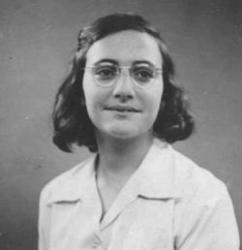
Margot Frank
 Germany
- Biography of Margot Frank
- Early Life and Education
- Personality and Relationships
- Hiding and Deportation
- Death and Legacy
Biography of Margot Frank
Margot Betty Frank, named after her maternal aunt Bettina Holländer, was born on February 16, 1926, in Frankfurt. She spent her childhood there with her parents, Otto Frank and Edith Frank-Holländer, and her sister. Margot was 16 years old when her family had to go into hiding on the upper floors of her father's office building, after receiving the order of deportation from the Gestapo. Margot's fate ultimately led her to perish in the Bergen-Belsen concentration camp. It is known from her younger sister Anne's diary that Margot also kept a diary, but it was never found.
Early Life and Education
Margot grew up in Frankfurt and attended the Ludwig-Richter School. However, due to the rising anti-Semitic sentiments in Germany following Adolf Hitler's appointment as Chancellor in January 1933, Margot, along with her family, decided to emigrate to the Netherlands. In June 1933, Edith and her daughters joined her mother in Aachen, before Otto found them a place to live in Amsterdam. Margot and her mother joined Otto on December 5, 1933, and Anne later joined them in February 1934. Margot attended the Jekerstraat Elementary School near their new home in southern Amsterdam. She excelled academically and demonstrated excellent performance. However, a year after the Nazi invasion of the Netherlands in 1940, she was transferred to a Jewish lyceum.
Personality and Relationships
Margot was remembered by her former classmates as a modest, reserved, and deeply religious girl. According to Anne's diary, their mother often asked Anne to follow Margot's example. While Anne admired her older sister in certain aspects, she also wanted to express her individuality and not imitate Margot. Margot had a better relationship with their mother than Anne did and was more shy, reserved, and tolerant in nature compared to Anne, who often spoke her mind. Margot followed her mother's example and actively participated in the Jewish community in Amsterdam. She attended synagogue, took Hebrew lessons, and joined the Zionist Youth Club in 1941, with the goal of immigrating to Palestine and becoming a midwife.
Hiding and Deportation
On July 5, 1942, Margot received a notice of deportation to a labor camp, which prompted the family to go into hiding in the secret annex of her father's office building. Four additional Jewish refugees joined them, and they lived in hiding for over two years until they were betrayed and arrested on August 4, 1944. Margot, along with the other inhabitants of the annex, was arrested by the Gestapo and spent a night in their headquarters before being transferred to a nearby prison for three days. On August 8, they were transported to the Westerbork transit camp. Due to their failure to respond to the earlier notice, the Frank family was considered criminals and sent to a disciplinary block where they were forced into hard labor disassembling batteries. On September 3, 1944, they were deported to Auschwitz on the last train carrying Dutch Jews to the death camp.
Death and Legacy
Margot and Anne were transferred to the Bergen-Belsen camp on October 30, where they both fell ill with typhus due to the appalling sanitary conditions. Margot Frank, aged 19, died in early March 1945, and Anne survived her only by a few days. They were buried together in a mass grave in the camp. Their father, Otto Frank, was the sole survivor from the hiding place. When he returned to Amsterdam, Anne's diary was given to him, but Margot's diary was never found.