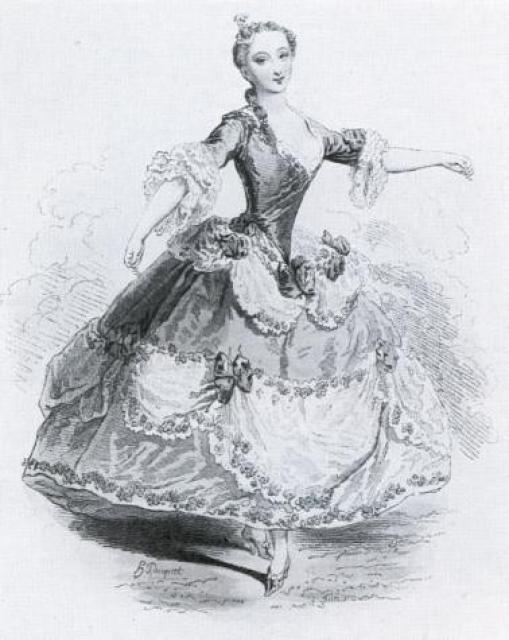
Maria Salle
 France
Biography of Marie Sallé
Marie Sallé was a French ballet artist and choreographer of the 18th century. She was born to an acrobat and began performing in Parisian fair theaters at the age of 11, where she caught the attention of the renowned dancer Françoise Prévost. Under Prévost's guidance, Sallé became one of the leading dancers at the Paris Opera.
Sallé made her debut in 1721, temporarily replacing Prévost in "Venetian Festivities" by Campra. However, she only received official recognition in France in 1727. In the years 1725-1727, Sallé was invited to perform in London at the Lincoln's Inn Fields theater. In England, she achieved great success in the so-called "John Rich's pantomimes," where ballet artists performed humorous pantomimes in the style of commedia dell'arte and enacted plots inspired by ancient mythology. Sallé returned to London several times under contract, where she not only danced as a prima ballerina but also choreographed her own ballets. In 1734, she staged the ballet-pantomime "Pygmalion" and the ballet "Bacchus and Ariadne."
In London, Sallé collaborated extensively with George Frideric Handel. She choreographed all the dances for his operas "Oreste," "Alcina," and "Ariodante." For the second version of the opera "Il Pastor Fido," Handel added a prologue specifically "for" Sallé, titled "Terpsichore." Despite her recognition abroad, Sallé also performed frequently in her homeland. She played leading roles in so-called opera-ballets such as "Galanterie of Europe" by Campra, "Galanterie of the Indies" by Rameau, and "Ballet of the Sentiments." She also appeared in operas by Jean-Baptiste Lully, as was typical for French operas of the 17th and 18th centuries, which incorporated ballet numbers.
From 1739 to 1752, Sallé was a frequent guest at Versailles. She was invited to perform in court spectacles, as Louis XV and his favorite, the Marquise de Pompadour, were great ballet enthusiasts. In her work, Sallé sought to connect dance with storytelling, using dance movements and mime to convey the narrative of the performance.
Sallé's focus as a dancer was not solely on technique but also on grace and the meaningfulness of dance. Breaking the conventions of 18th-century ballet, she performed "Pygmalion" in a light, close-to-antiquity costume with her hair down. However, while the English audience appreciated her openness to new concepts and artistic exploration, French spectators greeted her approach with caution.
Marie Sallé is rightfully considered one of the most interesting and significant figures in the history of 18th-century ballet. She was often referred to as the Terpsichore of France.


