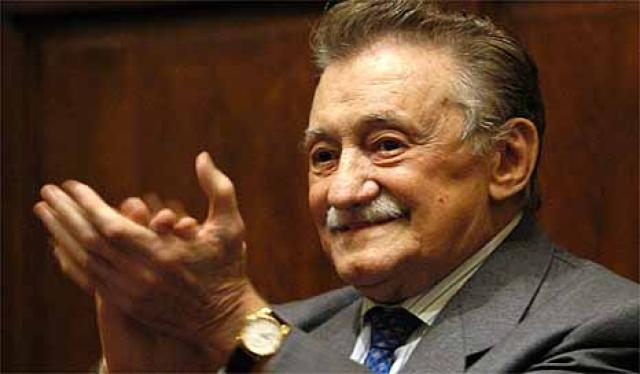
Mario Benedetti
 Uruguay
- Biography of Mario Benedetti
- Early Life and Education
- Writing Career and Political Involvement
- Later Years and Legacy
Biography of Mario Benedetti
Mario Orlando Hardy Hamlet Brenno Benedetti Farrugia, better known as Mario Benedetti, was born on September 14, 1920, in the Uruguayan city of Paso de los Toros. He was a Uruguayan writer, poet, and journalist, and is considered one of the greatest Latin American writers of the second half of the 20th century. Throughout his life, Benedetti published more than 80 books, many of which have been translated into over 20 languages worldwide.

Early Life and Education
Mario Benedetti was born into a family of Italian immigrants, Brenno and Matilde Farrugia. After arriving in Uruguay to avoid customs problems, his parents decided to change their last name to Benedetti. Mario spent his first two years in Paso de los Toros before the family moved to the city of Tacuarembó to start their own business. However, they fell victim to swindlers and lost their savings, so they relocated to the capital of Uruguay, Montevideo.

In 1928, Mario attended the Colegio Alemán de Montevideo, but financial difficulties led his parents to transfer him to Liceo Miranda in 1933. At the age of fourteen, Mario had to start working to support himself. He took on a job at Will L. Smith, a company that sold car parts. From 1938 to 1941, he lived mostly in Buenos Aires, Argentina.
Writing Career and Political Involvement
In 1945, Mario joined the publication Marcha, where he worked until 1974 when persecution from the government of Juan María Bordaberry began. In 1954, he became the director of one of Latin America's most renowned literary magazines, Número. In 1964, he worked as a theater critic for the magazine La mañana and also served as the editor and writer for the humorous magazine Peloduro.
During the late 1960s and early 1970s, Mario Benedetti became actively involved in public and political life. He was part of the Marxist-Leninist-oriented party "Movimiento 26 de Marzo," taught at a local university, and wrote several political stories. However, after the coup on June 27, 1973, Benedetti left the country and lived in Buenos Aires for a while before moving to Peru. There, he was arrested and deported back to Uruguay. Unable to stay in his homeland, he fled to Cuba and later settled in Madrid.
In 1976, Mario returned to Cuba and became the director of the Casa de las Américas foundation. In 1980, he moved to Palma de Mallorca. Two years later, he started working for the weekly newspaper El País. In the same year, he was awarded the Felix Varela Order by the State Council of Cuba. After the fall of the dictatorship in Uruguay in 1983, Mario Benedetti returned to his country and became the editor of the magazine Gap, which succeeded Marcha.
Later Years and Legacy
In 1985, the singer-songwriter Juan Manuel Serrat released an album featuring songs written with Mario Benedetti's poems. On November 30, 1996, Benedetti received the Premio Morosoli literature award. In his final years, Benedetti continued to work, receiving various awards from different countries around the world.
In 2006, his wife and closest companion, Luz López, passed away, which greatly affected Benedetti's health. He frequently traveled between Uruguay and Spain, and in his later years, he suffered from asthma and intestinal problems.
His last book, a collection of poetry called "Testigo de uno mismo," was published in 2008. On May 17, 2009, Mario Benedetti passed away at the age of 89 in his home in the capital of Montevideo.



