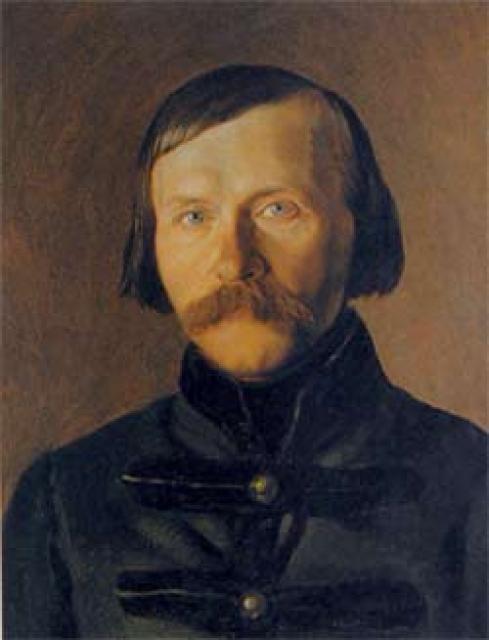
Petr Kireevskiy
 Russia
- Early Life and Family
- Parents and Childhood
- Influence of Vasily Zhukovsky
- Home Education and Literary Beginnings
- European Influence and the University of Munich
- Slavophilism in Germany
- Folklore Collecting and the Notion of a National Epic
- Collaboration with Pushkin and Other Scholars
- Frustrated Publication Attempts
- Later Life and Legacy
Early Life and Family
The Kirayevsky family was a distinguished noble lineage that traced its roots back to the service of Vasily Mikhailovich Feodorovich during the reign of Tsar Mikhail Feodorovich in the early 17th century. The family's ancestral estate was located in Dolbino, Tula Governorate.
Parents and Childhood
Vasily Ivanovich Kirayevsky, the father of Pyotr Kirayevsky, served in the Imperial Guard under Paul I and later retired to Dolbino, where he cultivated a passion for chemistry. Pyotr's mother, Avdotya Petrovna (née Yushkova), became a widow at the age of 23, leaving her with three young children: Ivan, Pyotr, and Maria.
Influence of Vasily Zhukovsky
The famous poet and future tutor to the heir to the throne, Vasily Zhukovsky, played a pivotal role in the lives of the young Kirayevskys. Zhukovsky, who was related to Pyotr's maternal family, developed a strong affection for his orphaned nieces and nephews. He introduced them to the world of literature and philosophy, encouraging their pursuit of intellectual endeavors.
Home Education and Literary Beginnings
Zhukovsky devised a comprehensive home education program for the Kirayevsky children. He urged Avdotya Petrovna to collect Russian folk tales and legends, recognizing their cultural and linguistic significance. This initiative laid the foundation for Pyotr's future work as a folklore collector. In 1828, Pyotr and Ivan debuted their literary talents in the journal "Moskovsky Vestnik," with Pyotr translating a work by Calderón.
European Influence and the University of Munich
In 1822, the Kirayevsky family relocated to Moscow to further their children's education. Both brothers enrolled in Moscow University and pursued a rigorous academic curriculum. In 1830, they traveled to Munich to attend the renowned University of Munich, where they immersed themselves in the intellectual climate of the time.
Slavophilism in Germany
While in Munich, the Kirayevsky brothers experienced a profound shift in their ideological orientation. They had previously been inclined towards Western thought, but their exposure to the teachings of Friedrich Schelling, the German philosopher, convinced them of the unique spiritual and cultural heritage of the Russian people. Pyotr wrote to his brother, "Only by living in Germany can one fully grasp the greatness of the Russian people, the freshness and flexibility of their abilities, and their vitality."
Folklore Collecting and the Notion of a National Epic
Upon his return to Russia, Pyotr Kirayevsky embarked on an ambitious project to collect and publish a comprehensive corpus of Russian folk songs. He believed that these songs held the key to unlocking the true nature of the Russian soul and its connection to the collective unconscious. Inspired by the idea of a "national epic," he envisioned a work that would surpass in scale and significance any previous collection of folklore.
Collaboration with Pushkin and Other Scholars
In 1833, Kirayevsky met with Alexander Pushkin, Sergei Sobolevsky, and Stepan Shevyrev, where they agreed to combine their own collections of folk songs into a single grand anthology. This collaboration marked a turning point in Kirayevsky's project, as it brought together the finest specimens of Russian folklore research at the time.
Frustrated Publication Attempts
Despite Kirayevsky's unwavering determination, his efforts to publish the anthology met with resistance from censorship authorities. The conservative climate of the time prevented the publication of works deemed too radical or subversive. In 1847, Kirayevsky was finally able to publish a portion of his collection under the title "Russian Folk Poems," which was met with critical acclaim.
Later Life and Legacy
During his final years, Kirayevsky continued to labor tirelessly on his folklore project, assisted by his devoted sister, Maria Vasilyevna. He passed away in 1856, leaving behind a monumental legacy that would profoundly shape the development of Russian literature, folklore studies, and national identity. His tireless efforts ensured that the richness and diversity of Russian folklore would be preserved for generations to come.


