Marion Donhoff
 Germany
- Biography of Marion Dönhoff
- Early Life and Education
- Opposition to the Nazi Regime
- Escape and New Life
- Journalistic Career and Activism
- Legacy and Contributions
Biography of Marion Dönhoff
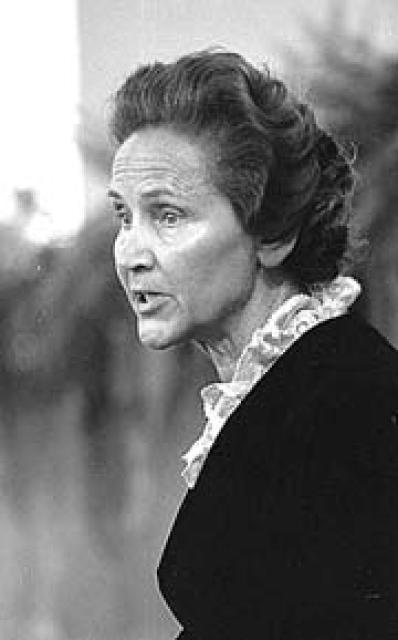
Marion Hedda Ilse Dönhoff, also known as the "grand dame of political journalism in Germany," was a German journalist and writer. She was born in 1909 on the ancestral estate of Friedrichstein in East Prussia, which is now part of the Kaliningrad region. Her father, Count August Carl Dönhoff, was a relative of the royal family and a member of the Reichstag. Her mother, Ria von Lepel, served as a lady-in-waiting to Empress Auguste Victoria. One of the Dönhoff family members had a fort named after them, Fort No. XI, part of the defensive ring around Königsberg. Marion was the fourth child in the family and grew up in a semi-feudal atmosphere surrounded by estates and hunting grounds.
Early Life and Education
Marion Dönhoff completed her education at a boys' gymnasium (high school) in Potsdam, where she was the only girl in her class. In 1932, she enrolled in the economics faculty at the University of Frankfurt. For her university diploma, she focused on the economic history of her family estate, which had a history of 700 years.
Opposition to the Nazi Regime
After the Nazis came to power, Marion Dönhoff openly opposed the regime. She earned the nickname "Red Countess" for her collaboration with communists. Despite the risks, she continued her opposition to the Nazis.
Escape and New Life
In January 1945, just before the arrival of the Red Army, Dönhoff fled Friedrichstein with little more than the clothes on her back. It took her seven weeks to reach Hamburg. From then on, a new life began for her and for all of Germany.
Journalistic Career and Activism
In 1946, Marion Dönhoff became one of the regular contributors to the weekly newspaper "Die Zeit." Her articles played a significant role in shaping the moral character of post-war Germany. In 1955, she became the head of the political section of "Die Zeit," and in 1968, she became its editor-in-chief. For her journalistic and publicist work, she was awarded the World Prize by the German Booksellers Association in 1971.
Marion Dönhoff was a member of the Academy of Fine Arts in Hamburg, an honorary member and vice president of the German Society for Foreign Policy, and a member of the PEN Center.
Legacy and Contributions
Marion Dönhoff considered it her duty to contribute to the restoration of political and cultural ties between the Federal Republic of Germany and Poland, as well as other Eastern European countries.
Even when separated from her homeland, Dönhoff felt a responsibility towards it. In 1944, fearing bombings, she obtained permission from the authorities in Königsberg to move a monument of Immanuel Kant, created by Christian Rauch, to her estate and hid it there. During the Soviet era, the monument was lost. Believing that what was taken from the city should be returned to it, Marion Dönhoff organized a campaign in the 1990s to restore the monument in Kaliningrad, donating a substantial sum for its production. In 1992, a bronze Kant statue was recast in Berlin by sculptor G. Haake based on the original miniature model, and it was returned to Kaliningrad. It now stands in front of the university building, which was visited by Vladimir Putin and Gerhard Schröder during the celebration of the city's anniversary in 2005.