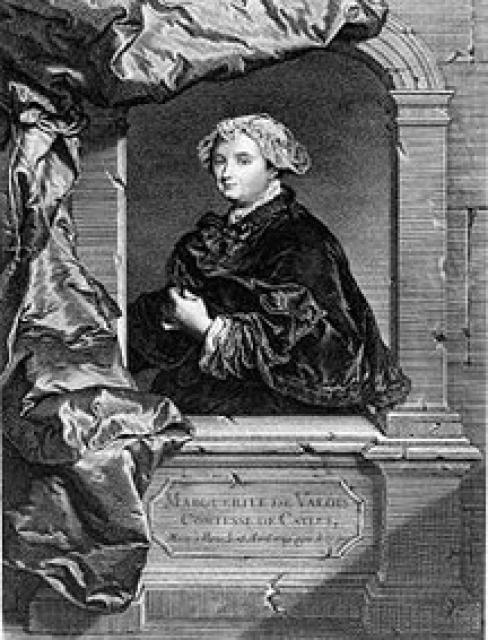
Marquise Caylus
- Sister of Kings, Wife in Name Only: The Life of Marguerite de Valois
- Childhood and Education
- A Pawn in Marriage Negotiations
- Forbidden Love and Political Expediency
- The Treacherous Wedding Night
- Betrayal, Exile, and Reconciliation
- Exile and Rebellion
- Captivity and Freedom
- Final Chapter
Sister of Kings, Wife in Name Only: The Life of Marguerite de Valois
Born into French royalty as the seventh child and third daughter of King Henry II and Catherine de' Medici, Marguerite de Valois found herself in a life of intrigue and political turmoil.
Childhood and Education
From a young age, Marguerite displayed a charming demeanor, an independent spirit, and a sharp intellect. Like many noblewomen of the Renaissance, she received a well-rounded education, mastering languages such as Latin, Ancient Greek, Italian, and Spanish, studying philosophy and literature, and showcasing a talent for writing.
A Pawn in Marriage Negotiations
From childhood, Marguerite's hand became a bargaining chip in diplomatic maneuvers. She was first sought after as a bride for Henry of Navarre, heir to the kingdom of Navarre, then for Don Carlos, the son of Philip II of Spain, and later for King Sebastian of Portugal. However, the uncompromising stance of the French court and rumors of Marguerite's unconventional behavior led to the failure of both the Spanish and Portuguese negotiations.
Forbidden Love and Political Expediency
Marguerite's heart was captured by the Duke of Guise, the de facto leader of the French Catholic League and a future claimant to the throne. However, King Charles IX and Catherine de' Medici forbade their union, fearing it would strengthen the Guise family and upset the balance between Catholics and Protestants. Despite the prohibition, Marguerite and Guise reportedly maintained a secret correspondence, suggesting their enduring affection for each other.
The Treacherous Wedding Night
For the sake of securing peace between Catholics and Huguenots, Marguerite was reluctantly married to Henry of Navarre on August 18, 1572. The lavish wedding was marred by the massacre known as the St. Bartholomew's Day Massacre, which erupted on the night of August 24. As the violence unfolded in the Louvre, Marguerite displayed remarkable courage and composure, saving the lives of several Huguenot nobles, including her husband.
Betrayal, Exile, and Reconciliation
When Henry of Navarre fled Paris in 1576, Marguerite remained as a hostage at the court of Henry III. In 1577, she embarked on a diplomatic mission to Spanish Flanders, where she represented the interests of her ambitious brother, Francis of Alençon. She escaped capture by Spanish forces, earning the admiration of the Austrian governor. Marguerite rejoined her husband in 1578 and established a brilliant court in Nérac, Navarre.
Exile and Rebellion
In 1583, Marguerite returned to Paris at her mother's insistence, only to clash with Henry III over her alleged infidelity and political maneuvering. She returned to Navarre, where she found herself isolated as Henry of Navarre pursued other romantic interests. With the death of Francis of Alençon in 1584, Henry became the heir presumptive to the French throne, diminishing Marguerite's role as a mediator. In 1585, she declared her support for the Catholic League and established herself in her own Catholic county of Agen.
Captivity and Freedom
After the failure of her ambitious plans, Marguerite was arrested and imprisoned in the castle of Usson in 1586. However, she was freed just two months later by the Duke of Guise. The Swiss guards assigned to her pledged their loyalty to her cause. Following the assassination of both Guise and Henry III, Marguerite found herself without allies. She remained in Usson for the next 18 years until 1605.
Final Chapter
With Henry of Navarre's accession to the French throne as Henry IV, Pope Clement VIII annulled his childless marriage to Marguerite on December 30, 1599. Marguerite lived out her final years in relative obscurity, reflecting on the turbulent events of her life as a pawn in political games and a woman of independent spirit.