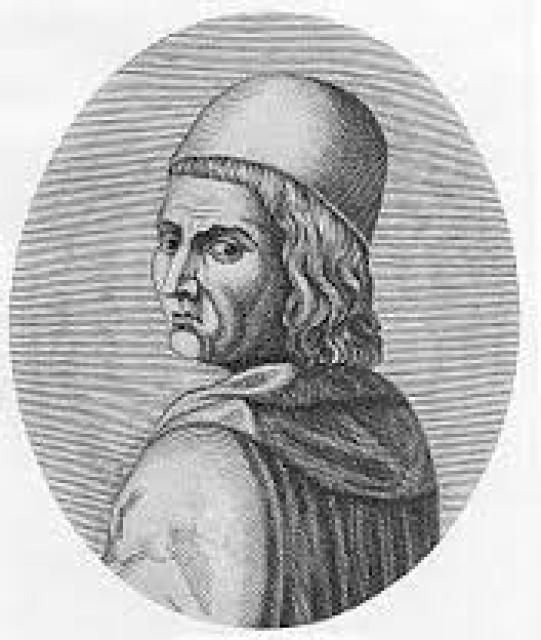
Marsilio Ficino
 Italy
Italy- Marsilio Ficino: Renaissance Philosopher, Theologian, and Scholar
- Platonic Academy and Neo-Platonic Translations
- Religious Career and Philosophical Commentary
- "Platonic Theology on the Immortality of the Soul"
- Theological, Medical, and Astrological Works
- Significance and Legacy
Marsilio Ficino: Renaissance Philosopher, Theologian, and Scholar
Early Life and InfluencesMarsilio Ficino was born in Figline Valdarno, near Florence, on October 19, 1433. From a young age, he exhibited a keen interest in Plato and his followers. With the patronage of Cosimo de' Medici and his successors, Ficino devoted himself entirely to intellectual pursuits. He studied Latin, Greek, philosophy, and medicine, likely in Florence.
Platonic Academy and Neo-Platonic Translations
In 1462, Ficino became the illustrious leader of the Platonic Academy in Florence, a central intellectual hub of the Renaissance. He produced masterful Latin translations of Plato and Plotinus, representing the first complete works of these philosophers in Western Europe (completed around 1470, published in 1484 and 1492). Ficino's translations were widely used until the 18th century, significantly influencing Renaissance thought.
Religious Career and Philosophical Commentary
Ficino became a priest in 1473, holding several ecclesiastical positions. His commentaries on Plato and Plotinus were highly utilized. Notably, his discourse on Plato's "Symposium" (1469), known as "On Love," served as a primary source for Renaissance reflections on the subject. Ficino believed that Plato's perspective on love was a spiritual connection between human beings, rooted in their innate love for God.
"Platonic Theology on the Immortality of the Soul"
Ficino's seminal philosophical work, "Platonic Theology on the Immortality of the Soul" (1469-1474), was a complex metaphysical treatise reconciling Platonic and Neo-Platonic teachings with Christian theology. This highly systematic book reduced the universe to five fundamental principles: God, the celestial spirit, the rational soul, quality, and the body. The central theme revolved around the immortality of the soul.
Theological, Medical, and Astrological Works
Ficino's other notable works included "Liber de Christiana Religione" (1474), a treatise on the Christian religion, as well as his vast correspondence, which provided valuable biographical and historical insights. He also authored works on theology, medicine, and astrology, such as "Three Books on Life" (1489).
Significance and Legacy
Marsilio Ficino was a pivotal figure in early Renaissance thought and the most prominent representative of Renaissance Platonism. His translations, commentaries, and philosophical writings greatly shaped the intellectual and spiritual landscape of his time. Ficino's legacy continues to be studied and debated, highlighting his lasting impact on Western philosophy and theology. He passed away in Careggi, near Florence, on October 1, 1499.


