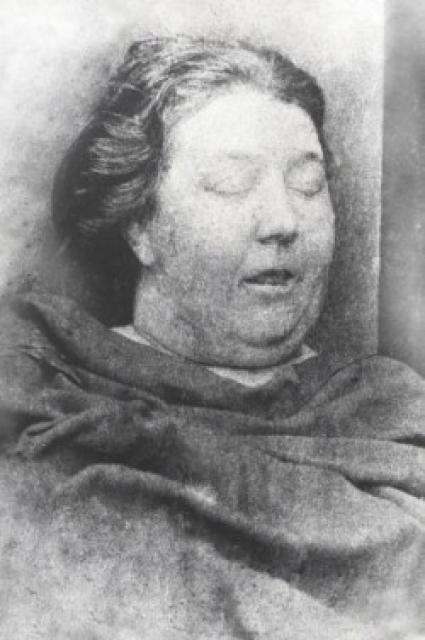
Martha Tabram
 Great Britain
Marta Tabram: A Possible Victim of Jack the Ripper
Marta Tabram, born Martha White, was a London prostitute and is believed to be one of the possible victims of the infamous unidentified serial killer known as Jack the Ripper. She was born on May 10, 1849, in the Southwark district of London, the daughter of warehouseman Charles Samuel White and his wife Elisabeth Dowsett. Marta was the youngest of five children in the family.
In May 1865, Marta's parents separated, and six months later her father passed away unexpectedly. She later started living with furniture packer Henry Samuel Tabram and married him on December 25, 1869. The couple moved to a house near Marta's childhood home in 1871. They had two sons together: Frederick John Tabram in February 1871 and Charles Henry Tabram in December 1872. However, their marriage was troubled due to Marta's alcoholism. Her drinking habits led to seizures, and her husband left her in 1875. He continued to provide her with financial support for three years, paying her 12 shillings per week. But upon discovering that she was living with another man, he reduced the amount to 2 shillings and 6 pence.
Marta had an on-again, off-again relationship with a carpenter named Henry Turner from 1876 until a few weeks before her death. Their relationship only fueled her drinking habits, causing her to spend nights away from home. In 1881, she and her sons found themselves on the list of residents at the homeless shelter on Thomas Street. By 1888, Marta was unemployed and occasionally resorted to selling herself and trinkets on the streets. However, the money she earned was not enough to afford housing, and she eventually moved into a lodging house on George Street.
On the Monday evening before her murder, Marta was drinking with another prostitute, Mary Ann Connelly, and two soldiers at the 'Angel and Crown' public house near George Yard. After dividing their customers, the two women parted ways at around 11:45 pm. Marta and her soldier companions headed towards George Yard through a narrow alley connecting Wentworth Street and the main street of Whitechapel.
In the early hours of the night, one of the residents of George Yard, Mrs. Hewitt, was awakened by screams of "Murder!" However, violence and loud noises were common in the area, so she ignored the commotion. At 2:00 am, two other residents, Joseph and Elizabeth Mahoney, a married couple, returned home without noticing anything suspicious. Around the same time, Officer Thomas Barrett encountered a Grenadier from the Tower of London wandering in the darkness. The Grenadier claimed to be waiting for his friend in the area. Albert George Crow, a cab driver returning from his night shift at 3:30 am, noticed Marta's body lying on the first flight of stairs. It was quite dark, and he mistook her for a sleeping vagrant. It wasn't until around 5:00 am, when dockworker John Saunders Reeves descended the stairs for work, that he realized the woman was dead. Reeves brought the body to Barrett, who sent for Dr. Timothy Robert Killeen to examine the corpse. Dr. Killeen arrived around 5:30 am and estimated that Marta had been dead for about three hours. She had suffered 39 knife wounds, including 9 to the throat, 5 to the left lung, 2 to the right elbow, one to the heart, 5 to the liver, 2 to the spleen, and 6 to the stomach. The lower abdomen and genitals were also mutilated. Marta's body was found lying on her back, with her clothing partially lifted, suggesting possible sexual assault. However, Dr. Killeen found no conclusive evidence of sexual intercourse.
The investigation into Marta's murder was led by Edmund Reid. On August 7, 1888, he instructed Barrett to visit the Tower in the hope that the officer could identify the Grenadier. The next day, Barrett initially identified one suspect but later changed his mind and pointed to another. Barrett explained that he had seen a man without any medals on George Yard, thus ruling out the first suspect. The second detainee, John Leary, claimed that on the night of the murder, he went drinking with his friend Law in Brixton. According to Leary, they separated and only met again at 4:30 am before heading to Billingsgate and then back to the Tower. Law corroborated Leary's story, and the latter was released due to lack of evidence. On August 13, prostitute Mary Ann Connelly was also brought to the Tower but failed to identify any Grenadier who resembled Marta's client. She claimed that the soldiers had white hatbands that night. This remark led investigators to abandon the search among the Grenadiers and shift their focus to the Coldstream Guards. Connelly was taken to Wellington Barracks, where she identified two soldiers. However, both soldiers had solid alibis. One was at home with his wife, and the other had not left the barracks on the night of the murder.
Marta's body was officially identified by her husband on August 14, 1888. At the time of her death, she was wearing a black bonnet, a long black jacket, a dark green skirt, a brown petticoat, and worn-out spring boots. She was a well-built brunette, standing 159 cm tall. The investigation reached a dead end, suggesting that the killer might have been a group of individuals, such as a local gang or a lone perpetrator.
In early September, Marta's murder was linked to the killings of Emma Elizabeth Smith on April 3 and Mary Ann Nichols on August 31. Before her death, Smith had told the police that she was attacked by a gang. Marta Tabram's case was later also connected to four more murders: Annie Chapman on September 8, Elizabeth Stride and Catherine Eddowes, both on September 30, and Mary Jane Kelly on November 9, 1888. These victims, excluding Smith, are now commonly referred to as the "canonical five" of Jack the Ripper.
There is much debate regarding whether Marta Tabram was indeed a victim of Jack the Ripper. However, it is possible that she was one of his early victims before the serial killer changed his modus operandi.