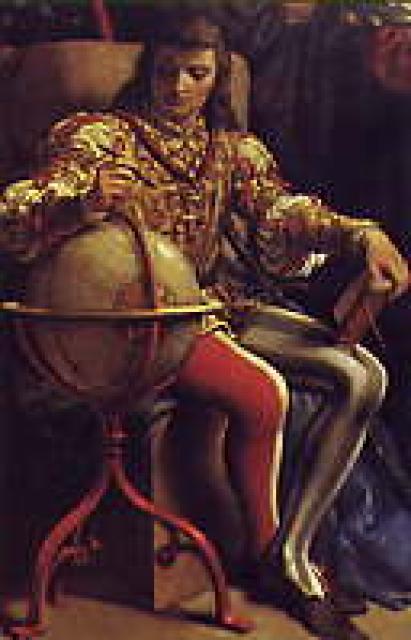
Martin Behaim
 Germany
Biography
Martin Behaim was a German scientist, merchant, and explorer who served the Portuguese for a long time. He is known as the creator of the oldest surviving globe.
Early Life and Career
Behaim was born in the wealthy merchant family in the free city of Nuremberg, Franconia. His father traded with Venice and was elected to the city senate. From a young age, Martin was involved in his father's business. After his father's death in 1474, he worked with his uncle Leonard and Jorius van Dorpp, a cloth merchant from Mechelen. He also attended the Frankfurt fair. In 1478, Behaim moved to Antwerp, where he worked in a dyeing workshop and learned arithmetic. There are reports that he studied under Johann Müller, a renowned astronomer and mathematician of the time.
Life in Portugal and Marriage
In 1484, Behaim first appeared in Lisbon for trading purposes, as Portugal was expanding its connections with Flanders and the Hanseatic League. A year later, he was knighted by King João II. In 1488, he married the daughter of his friend Joss van Huerter, a Flemish man in Portuguese service who held the position of governor of the islands of Pico and Faial in the Azores archipelago. This marriage allowed Behaim to get closer to the court and possibly obtain the position of court astronomer and cartographer. According to the Spanish chronicler Antonio de Herrera, Christopher Columbus met with Behaim and discussed his project of sailing to India in the west. Herrera claimed that Columbus "found confirmation of his opinion from Martin of Bohemia, his friend, a Portuguese from the island of Faial and a knowledgeable cosmographer." Behaim was also associated with the "circle of mathematicians," a society of court scholars primarily concerned with physics, astronomy, and navigation. There is evidence that Behaim participated in Diogo Cão's voyage to the African coast in 1484. The expedition lasted 19 months, during which the Portuguese discovered previously unknown areas of Gambia and Guinea, established contacts with the Wolof people, reached the mouth of the Congo River, and returned with a cargo of spices.
The Behaim Globe
In 1490, Behaim returned to his hometown for trading purposes and to claim his mother's inheritance. Georg Holzschuher, a member of the city council who had traveled to Egypt and the Holy Land and was interested in geographic discoveries, convinced Behaim to stay in Nuremberg and create a globe reflecting the latest Portuguese discoveries. By 1494, the globe, known as the "Erdapfel" or "Behaim Globe," was completed. It had a diameter of 507 mm and depicted the geographical knowledge of Europeans before the discovery of America. Although it did not use the modern method of indicating latitude and longitude, it included the equator, meridians, tropics, and zodiac signs. The globe also featured brief descriptions of various countries and illustrations of their inhabitants.
Later Life
In July 1493, Martin Behaim returned to Portugal. Information about his life after creating the Behaim Globe is scarce. It is known that he engaged in trade on the island of Faial until 1506 and then moved to Lisbon. He died there on July 29, 1507, in great poverty, and the reasons for his impoverished state remain unknown.