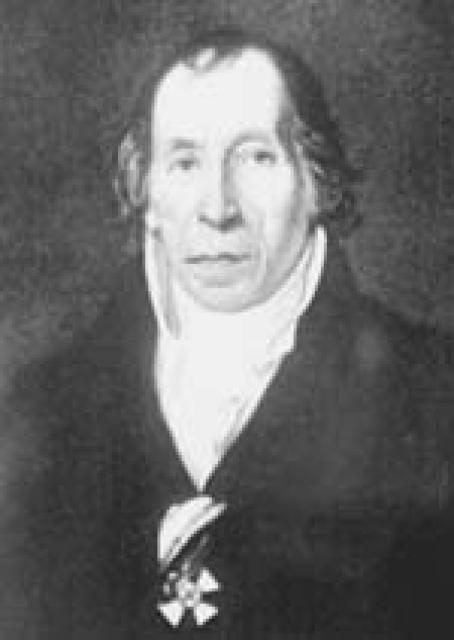
Martin-Genrih Klaprot
 Germany
- Biography of Martin Heinrich Klaproth
- Early Life and Education
- Career and Discoveries
- Legacy and Publications
Biography of Martin Heinrich Klaproth
IntroductionMartin Heinrich Klaproth was a German chemist who made significant contributions to the fields of inorganic and analytical chemistry. He was a member of the Berlin Academy of Sciences and an honorary foreign member of the St. Petersburg Academy of Sciences.
Early Life and Education
Klaproth was born in Vernigerode and initially worked in pharmacies in Hannover, Berlin, and Danzig. In 1780, he established his own laboratory in Berlin.
Career and Discoveries
Klaproth's major works revolved around the study of minerals and elements. He discovered uranium and zirconium in 1789, and titanium in 1795. Independently of I. J. Berzelius and Swedish chemist W. G. Hisinger, Klaproth discovered cerium in 1803. He also conducted research on strontium compounds in 1793, chromium in 1797, and tellurium in 1798.
In 1792, Klaproth replicated the important experiments of Antoine Lavoisier during a meeting of the Berlin Academy of Sciences. His replication contributed to the wider acceptance of Lavoisier's ideas in Germany.
Klaproth also made notable observations in the field of meteorite analysis. He determined that nickel is a constant companion of iron in iron meteorites.
Furthermore, while studying leucites, Klaproth discovered the presence of potassium in these minerals. This finding was significant as it demonstrated for the first time that potassium is not only found in plants but also in minerals.
Legacy and Publications
Klaproth's works were published under the title "Contributions to the Chemical Knowledge of Mineral Substances" (Volumes 1-5, 1795-1810). In 1810, he became a professor at the University of Berlin after teaching at the Templehof Artillery School since 1792.
Martin Heinrich Klaproth's discoveries and research laid the foundation for further advancements in the field of chemistry. His contributions to the understanding of elements and minerals continue to be recognized and celebrated in the scientific community.


