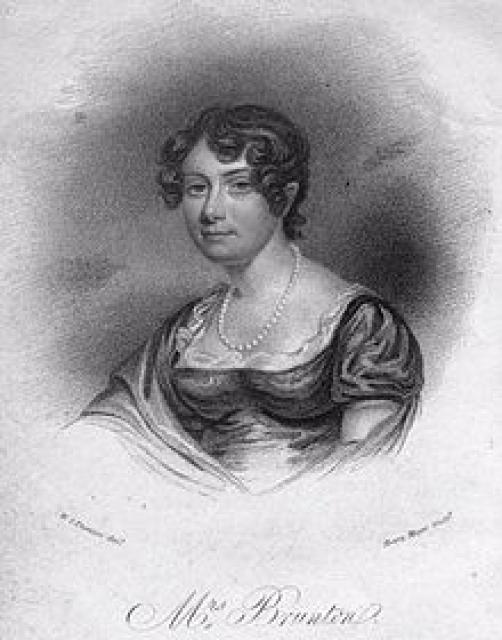
Mary Brunton
 Great Britain
Biography of Mary Branton
Mary Branton, born Mary Balfour, was a Scottish writer known for the beauty and conciseness of her style, sharp observations, and elevated emotions that permeated her novels. She was born on November 1, 1778, in Burray, one of the Orkney Islands. Her father, Colonel Thomas Balfour, served in the British Army, and her mother, Francis Ligonier, was the sister of the second Earl Ligonier. Mary received a rather limited education, although her mother taught her music, Italian, and French.
In approximately 1798, Mary met and fell in love with the Reverend Alexander Branton, a Scottish clergyman who later became a professor of Oriental languages at the University of Edinburgh. Mary's mother disapproved of her relationship with Alexander, but that did not stop her from eloping with him on December 4, 1798. He took her away from the island of Gairsay in a rowboat. Alexander resigned from his church duties in 1813. The writer's marriage was a happy one, although she was unable to conceive a child. Inspired by her husband, Branton developed a slight interest in philosophy. In one of her letters, she mentioned her support for women studying ancient languages and mathematics, activities that were uncommon for women at the time.
In 1809, the couple traveled to Harrogate and the English Lake District. However, Mary did not have a favorable opinion of the English town of Harrogate, stating, "A landscape without hills seems to me as interesting as a face without a nose."
She completed her first novel, "Self-Control," in 1809 and published it in 1811. The work was well-received by Charlotte Barrett, the niece of novelists Fanny Burney and Sarah Burney, and the mother of writer Julia Maitland. In the book, Mary advanced the redefinition of femininity by contrasting self-control with sensitivity. The novel gained wide popularity and reached Paris in 1829. Her other novel, "Discipline," was published in 1814 and, like Walter Scott's historical novel "Waverley" published in the same year, received high praise for its depiction of the Scottish Highlands.
In 1815, Branton and her husband visited London, during which she began learning Gaelic. Her third novel, "Emmeline," was left unfinished at the time of her death.
The success of Branton's works can be attributed to the combination of strict morality and a reverent approach to events that were "on the edge" or outright violated social norms. The presence of "pulsating sexuality" in her books is certainly exaggerated. However, the true interest lies in the process of women's independent struggle with deprivation and the rise from despair through the acquisition and cultivation of spiritual strength. Writer Fay Weldon notes that Branton's novels could certainly be improved, but also acknowledges that these works are inherently engaging, full of novelty, invention, insightful observations, and erotic concepts.
Branton was in her forties when she finally conceived a child. She died on December 7, 1818, in Edinburgh after giving birth to a stillborn son. Her husband passed away on February 9, 1854, in Coupar Angus, Perthshire.


