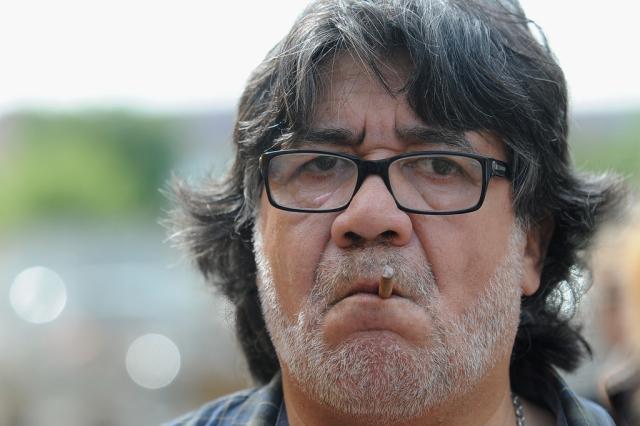
Luis Sepulveda
 Chile
Chile- Biography of Luis Sepulveda
- Early Life and Education
- Political Engagement and Imprisonment
- Life in Exile and Literary Success
Biography of Luis Sepulveda
Luis Sepulveda is a Chilean writer, journalist, director, political activist, and one of the most well-known activists of the Greenpeace society. Born on October 4, 1949, in Ovalle, Limari Province, Chile, Sepulveda had a life full of unique experiences that shaped his career as a writer.

Early Life and Education
Sepulveda's mother, who came from the Mapuche indigenous tribe, was a nurse, while his father, who later joined the Chilean Communist Party, owned a small restaurant. Due to the unstable political situation in the country, Sepulveda's parents tried to keep him away from politics. He studied in Santiago, the capital of Chile, and later enrolled in the National University of Chile, where he studied playwriting and theater arts.

Political Engagement and Imprisonment
Despite his parents' efforts to shield him from politics, Sepulveda became actively involved in the political life of the country during his time as a student. He edited small youth magazines and wrote articles for prominent publications. His political stance was not oppositional but called for certain changes in the country. In 1973, a military coup took place in Chile, and Sepulveda publicly disavowed cooperation with the new government. As a result, he was sentenced to two and a half years in prison, where he endured regular torture. Fortunately, due to external intervention, Sepulveda was transferred to house arrest a few months later. This brief period of confinement was cut short when Sepulveda escaped and went into hiding for over a year. During this time, he co-founded a theater group with his friends and organized secret performances, which became a center of cultural resistance. After a year, authorities captured Sepulveda again while attempting to blow up important political targets. He was sentenced to life imprisonment in one of the country's most notorious prisons. Once again, fate intervened. Through the decision of Amnesty International, his sentence was reduced to 28 years, and he was eventually exiled to Sweden for eight years.

Life in Exile and Literary Success
For many, such an ending would be considered a complete triumph, but not for the patriotic Sepulveda. On his way to Sweden, he escaped to Uruguay but realized that all his friends were still imprisoned. He then moved to Brazil and later to Paraguay. After several months of wandering, Sepulveda settled in Quito, Ecuador, where he established a theater and collaborated with UNESCO experts in studying the effects of colonization on the indigenous Shuar tribe. It was during this time that Sepulveda realized that Latin America was burning with revolutions not because of people, but because nature itself protested against violent and abrupt colonization that contradicted the laws of nature and humanity.
In 1979, Sepulveda joined the Simón Bolívar International Brigade and fought against the dictatorship in Nicaragua. After their victory, he moved to Germany, where he actively worked on his novels and stories and became involved in environmental activism with Greenpeace. His first collection of stories was completed when Sepulveda was only 17 years old. He also worked as a journalist for a local newspaper, where the editor happened to be a regular customer at his father's restaurant. Although he generated many ideas for new works during his wanderings, he published them much later.
Sepulveda's most famous novel, "The Old Man Who Read Love Stories," was published in 1989 and quickly became a global bestseller. This emotionally charged story about a single individual, in which each reader finds something of themselves, has been translated into numerous languages and has undergone several reprints. His other novels gained popularity in Latin America and Spain, with their Russian translations being relatively recent. Currently, Luis Sepulveda resides in Europe with his family. Recent reports suggest that he is retiring from writing, but the author himself has not confirmed this information.




