
Mary Pembroke
 Great Britain
- Biography of Mary Herbert, Countess of Pembroke
- England, Whitehall, the residence of Elizabeth Tudor. 1575.
- In the end, Queen Elizabeth had her doubts.
Biography of Mary Herbert, Countess of Pembroke
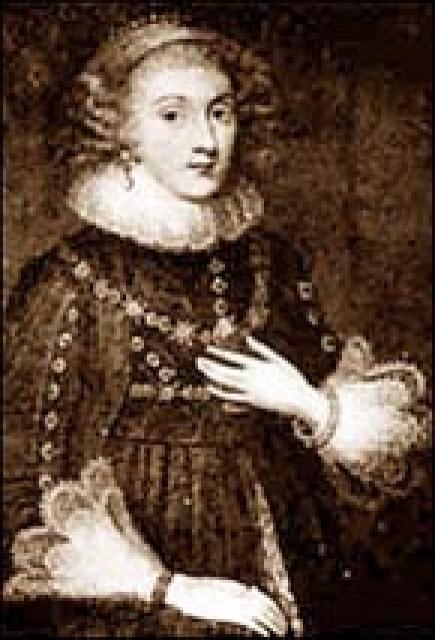
Mary Herbert, Countess of Pembroke, also known as Delia or Mary Herbert-Sidney, was a lady-in-waiting to Queen Elizabeth I. She was fluent in French, Italian, and German, which was highly unusual for women during the Middle Ages. She was also a talented musician and was considered the second most educated lady at the court after the Queen.
After marrying, Lady Pembroke, a young beauty, gathered around her the most famous poets, musicians, and artists, including Spencer, Drayton, Daniel, and her own poet brothers, Philip and Robert Sidney. She created a literary salon called "The Academy" in her husband's estate, Wilton Place, in Salisbury, which became renowned throughout England. She was the muse for many famous sonnets by Samuel Daniel, including "To Delia". Lady Pembroke died in 1621 in London and was buried in Salisbury Cathedral. The dates of her birth and death are unknown.
Little is known about this woman to ordinary readers and literature enthusiasts. Her name might spark a vague recognition in the mind of a well-read literary scholar or translator, but they would quickly dismiss it as unimportant. However, I persistently flip through the yellowed anthology titled "West European Sonnets of the 16th-17th centuries", and the passionate tercets echo in my ears: "When she sees the signs of her sad autumn in the mirror, let the past times revive and my sorcery sonnets awaken her. Resurrected with fiery verses, she, like a Phoenix, will not recognize the years."
So who is this Woman who stirs such deep emotions, such fervent lines? Is it time to truly resurrect her from the ashes of oblivion? Let us try to forever preserve her image - the only thing immune to Time - the Magic of words.
England, Whitehall, the residence of Elizabeth Tudor. 1575.
The Queen clapped her hands lightly, interrupting the even voice of the reader, and the court ladies shifted nervously on their benches like startled butterflies or flowers awakened by the first rays of the sun.
"Enough, that's enough!" - the Queen's chin twitched nervously, her elongated white face turned slightly pink with the anger she was trying to contain. "How could such liberties be written? And they call this book the best of the best! Tell the court librarians to be more careful in their choice of reading for the Queen of England! Now all of you, go away, you sleepy hens, I'll call you if I need you!" she said, her clear whisper-like voice sounding more like a hiss. The cozy room with oak-paneled walls and color-stained glass windows emptied instantly.
"And you, Lady Mary, where are you going? Stay! I have a few words to say to you!" Lady Mary Herbert-Sidney, who was already almost at the door, quickly bent her knees in a curtsy, her finger holding the pages of the book in its ancient, half-worn velvet binding. Her white, lavish cuffs partially concealed not only her slender fingers, but also the title of the book - golden letters on a dark brown cover. The Queen vainly squinted her nearsighted eyes, trying to read the title. She grew more and more angry.
"So, what was it that tortured my ears today? What is the name of this audacious mix of frivolous innuendos and obscure musings? Speak clearly, so that even the walls can hear you! What's the point of hiding the author's name if the book is already written and is disturbing minds and hearts?!"
"'Orlando Furioso' by Ariosto, Your Majesty!" Lady Mary Herbert-Sidney said quietly, yet firmly. "This book was created in the 14th century by an Italian poet..."
"I know!" the Queen interrupted her sharply. "Were you afraid that I would order him to be executed? Do you think of me as a power-hungry ignoramus?"
"Not at all, Your Majesty. I just..." Lady Mary hesitated, blushing like a poppy, and raised her head higher. The Queen's tone softened instantly.
"Well, well, my dear, I didn't mean to offend you! Your brother Philip causes a lot of trouble for me and Lord Dudley, his uncle."
"Why, Your Majesty?" Mary's voice rang with tension. She tried to swallow the subtle insult that had been given to her.
"He is too stubborn. He has a bright future as a diplomat, but he wastes himself on noisy revelries and fights. On dubious acquaintances. This Marlowe... Who is he?"
The Queen, rustling her skirts, approached the tall Venetian window, her fingers lightly drumming on the intricately patterned frame. Mary suddenly felt awkward and cold next to the towering, impenetrable ruler. The Queen's elaborate hairstyle made her even taller, and for a brief moment, Mary felt like a lost grain of sand in her palm, about to be flicked away and go unnoticed. Internally, Mary shrank, while outwardly she spoke with a steady voice.
"Christopher Marlowe is a poet, Your Majesty. He is writing something at night... a political treatise, it seems. I don't know much about it."
"And did your brother Philip bring you this book from his travels? I hope he didn't intend to morally corrupt you?" The Queen smirked unpleasantly, her eyes gleaming ominously.
"I don't know, Your Majesty! There are many legends about Ariosto; it's hard to distinguish fact from fiction..."
"Did your brother Philip bring you this book from his travels? I hope he didn't intend to morally corrupt you?" The Queen smirked unpleasantly, her eyes gleaming ominously.
"I don't know, Your Majesty! There are many legends about Ariosto; it's hard to distinguish fact from fiction..."
"Your brother Philip adored my stepmother, Catherine Parr, sincerely as well, but that didn't stop him..." Suddenly, her whole face contorted in a painful spasm, and a shadow fell upon it. Mary looked at Elizabeth in bewilderment. She had never seen her like this before.
"What's happening to you, Your Majesty? Are you feeling unwell? Should I call the physician?" She reached for the bell on one of the tables, but the Queen firmly grabbed her hand.
"No need! There are already too many ears in the palace for my secrets. They don't need to know another one!" She forced a smile. "Just remember, you can't always rely on the voice of your heart - reason is more important. You must understand this, Mary. You are clever, and you must understand me. You are not a match for Philip. God has a different path for him, and for you too. Remember your sisterly duty. I can't say more, forgive me!"
"I understand, Your Majesty!" Mary's voice, tinged with tension, stumbled upon an invisible barrier. The heavy oak door silenced everything: the footsteps, the restrained sobbing, if there were any.
In the end, Queen Elizabeth had her doubts.
Two months after that evening conversation, the brilliant court of Queen Elizabeth I of England celebrated the lavish wedding of the niece of the all-powerful Sir Robert Dudley - Mary Herbert - to the Earl of Pembroke. The groom was one and a half times older than the bride, but no one seemed to mind, especially since Lady Mary herself appeared calm and radiant!
After the wedding, the newlyweds immediately left for the extensive estate of the Earl of Pembroke in Salisbury, called Wilton Place. Everyone marveled at how such a dazzling beauty, fluent in three languages, including Latin, and passionate about music and dance, willingly condemned herself to seclusion in the remote countryside. However, the astonishment was hushed: no one wanted to invoke the wrath of Queen Elizabeth, who showered the newlyweds with her exquisite attention and lavish gifts, playfully promising to be the godmother of all the future children of the Countess of Pembroke. She had to fulfill this promise four times.
However, malicious tongues claimed that the father of Lady Pembroke's children was not her barren and aging husband, but someone who occupied a private corner in her heart. But we shall not rush after those frank and shameless gossips. In the hands of Heaven, all secrets of the heart, soul, and body are safe...
England, 1585. Salisbury, Wilton-Place, the estate of the Countess of Pembroke.
"Susan, what else do you want?" Lady Mary impatiently put aside the creaking pen. The translation of the psalm didn't go well this morning - only the first five stanzas of the second verse were completed. If the work wasn't progressing, at least a small part of it should be saved!
"Your Grace, you have another heartfelt message from Mr. Daniel!" The maid tried to suppress her smile (or smirk), but her eyes sparkled mischievously.
Mary, reaching for the sand container, opened the lid and sprinkled the white paper with yellowish grains - if the work wasn't going well, at least a small part of it wouldn't be lost!
"What about today's reception? Everything seems to be ready for a long time!" Mary reached for the sand container, opened the lid, and sprinkled the white paper with yellowish grains - if the work wasn't going well, at least a small part of it wouldn't be lost!
"What about today's reception? Everything seems to be ready for a long time!"


