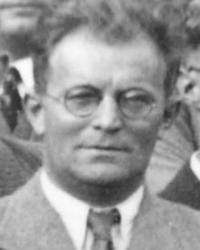
Max Abraham
 Germany
- Max Abraham
- Academic Career
- Scientific Contributions
- Structure of the Electron
- Theory of Gravitation
- Light and Gravitation
Max Abraham
Early Life and EducationBorn into a Jewish family, Max Abraham was a German theoretical physicist. He graduated from the University of Berlin in 1897 and subsequently worked as an assistant to Max Planck.
Academic Career
From 1902 to 1909, Abraham held the position of privatdozent in Göttingen. He worked in the United States and Italy (Milan) from 1909 to 1914. With the outbreak of World War I, he was compelled to return to Germany, where he worked on the theory of radio signal transmission at the Stuttgart Institute of Technology. After the war, he returned to Milan, then to Stuttgart and Aachen. He succumbed to a brain tumor in 1922.
Scientific Contributions
Mathematical Physics, Electrodynamics, and Electron TheoryAbraham's primary scientific interests were in mathematical physics, electrodynamics, and the electron theory. He made significant contributions to Maxwell's classical electrodynamics, bringing it to its modern form.
Structure of the Electron
In 1902-1903, Abraham proposed the first hypothesis regarding the structure of the electron, suggesting that it could be represented as a solid sphere with a uniformly distributed charge. He introduced the concept of electron momentum in theoretical physics and proposed a formula describing the dependence of an electron's electromagnetic mass on its velocity.
Theory of Gravitation
In 1912, Abraham proposed a theory of gravitation that extended Newton's theory but did not consider Einstein's principle of equivalence.
Light and Gravitation
Abraham's hypothesis on the force exerted by light passing through a transparent medium was initially rejected in favor of Hermann Minkowski's hypothesis. However, recent experiments have led some physicists to conclude that Abraham's hypothesis may be correct. The majority of the physics community, however, disagrees.