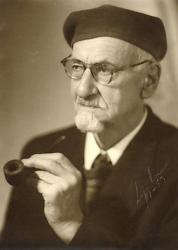
Max Kalbeck
 Germany
- Max Kalbeck: Poet, Musicologist, and Music Critic
- Early Life and Education
- Career in Music Criticism and Writing
- Biographer of Brahms
- Opera Translations and Original Librettos
- Poetry and Song
Max Kalbeck: Poet, Musicologist, and Music Critic
Max Kalbeck, a German poet, musicologist, and music critic, left an enduring legacy in the world of music and literature.
Early Life and Education
Born in Breslau, Prussia (now Wrocław, Poland), Kalbeck began his musical education under Peter Lustner. In 1861, he joined the boys' choir led by Leopold Damrosch. After graduating from high school, he pursued law at the University of Breslau, followed by philosophy at the University of Munich. However, his passion for music led him to study at the Munich Conservatory under Josef Rheinberger (composition), Franz Wüllner (choral singing), and Josef Walter (violin).
Career in Music Criticism and Writing
Upon returning to Breslau in 1874, Kalbeck became a music critic for regional newspapers and served as assistant director of the Silesian Museum of Fine Arts. In 1880, Eduard Hanslick invited him to Vienna, where he resided and published as a music critic for the rest of his life.
Biographer of Brahms
Kalbeck is best known for his multi-volume biography of Johannes Brahms (1904-1914), with whom he shared a close friendship for many years. He also published a volume of Brahms's selected correspondence.
Opera Translations and Original Librettos
Kalbeck translated approximately 30 opera librettos into German, often with notable revisions. These included Mozart's "Don Giovanni" (1886), Gluck's "Orpheus and Eurydice" (1896), and works by Bizet, Smetana, Verdi, Massenet, and Tchaikovsky ("The Queen of Spades," 1902). He also penned original texts for the operetta "Jabuka" by Johann Strauss (1895), the opera "Die Stille Stadt" by Adele von Filitz (1897), and the opera "Der Flötenspieler von Decize" by Eduard Poldini (1899).
Poetry and Song
Kalbeck's literary output included numerous collections of poetry, such as "Aus Natur und Leben," "Wintergrün," and "Nächte." Several of his poems were set to music by Johannes Brahms.