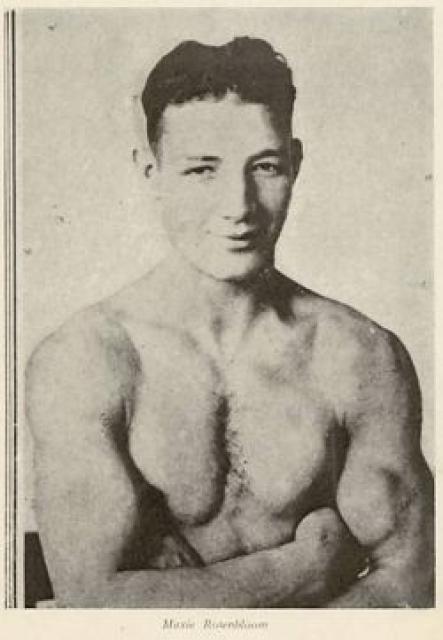
Maxie Rosenbloom
 USA
USAMaxie Rosenbloom: Biography of a Boxing Champion
Maxie Rosenbloom, also known as Max Everitt Rosenbloom, was born on September 6, 1906, in Leonard's Bridge, Connecticut, USA. He came from a family of Russian Jewish immigrants and later moved to New York City. Growing up in the Lower East Side and Harlem, Maxie developed a fighter's spirit from a young age. He even got expelled from school after getting into a fight with his teacher in the fifth grade. Despite his troublemaking, Maxie continued his education at Hawthorne School for troubled teenagers.
His boxing journey began under the influence of his brother, who fought under the name Leonard Rose. However, another story suggests that Maxie was introduced to boxing by actor George Raft, who noticed him during a street fight. Maxie's amateur career didn't start off well as he lost his first six fights, and out of his first 25 fights, he lost 20. However, his fortunes changed when he started training with Frank Bachman.
In 1923, after approximately 200 amateur fights, Maxie turned professional as a welterweight. He won his first fight by knockout, but he still had to work various odd jobs, such as being a lift operator, railroad worker, and even a bodyguard, to support himself. Maxie's determination to fight led him to have 23 fights in 1924 alone, as he transitioned to middleweight. Known as a "slagger," Maxie was a street fighter, but after a brutal fight with Hambo Kelly, he started focusing more on defense.
After a draw against middleweight champion Harry Greb in July 1925, Maxie had 36 wins and one draw to his name. Following the fight with Greb, The Ring magazine ranked Maxie as the tenth contender for the world title. It was around this time that Maxie acquired his nickname "Slapsie" from sports reporter Dave Runion for his unconventional style. Maxie had a weak punch but was a defensive genius. He often fought with his glove's inner side, as if slapping his opponents, hence the nickname. Although this style was not popular with boxing purists or spectators, it proved to be effective.
From 1926 onward, Maxie faced formidable opponents. He defeated Frank Moody, the Welsh middleweight champion, and fought Dave Slayde and former middleweight champion Johnny Wilson twice each. In the same year, Maxie faced current world champion Tiger Flowers. In the ninth round, Flowers delivered a low blow and was disqualified. Maxie won the fight, but he couldn't claim the title due to disqualification rules.
Maxie's first defeat came at the hands of Jimmy Slattery. He faced Slattery seven times, losing four of those fights. In 1927, they met for the third time, this time for the NBA championship. Slattery, who had won their previous two encounters, won the fight by points. Just a few months later, Maxie had another series of three draws against Tiger Flowers. Shortly after, he defeated the strong boxer Pete Latzo. Between 1928 and 1929, Maxie fought in 48 bouts and became a top contender for the world title. He defeated Jack McVey and the renowned Ted "Kid" Lewis during this period. Maxie defeated McVey again in 1929 but lost to Slattery. Slattery became the NBA world champion in the light heavyweight division that year. In June 1930, Maxie finally defeated Slattery, his nemesis, in their fifth encounter. Maxie won by points after a grueling 15-round fight, becoming the world champion. Even the New York Boxing Commission, which disapproved of Maxie's style, recognized him as the new champion. This victory solidified his reputation as the best light heavyweight of his time.
On July 14, 1932, Maxie successfully defended his title against Lou Scozza, solidifying his position as the undisputed champion. From then on, Maxie fought frequently, defending his title once more in 1933. He faced a historic bout against German boxer Adolf Heuser, despite Nazi Germany proclaiming Aryan superiority in sports. In a fifteen-round battle, Maxie defeated Heuser using his trademark style, ridiculing him throughout the fight. Following this victory, Adolf Hitler prohibited German athletes from competing against Jewish athletes. Just weeks after defeating Heuser, Maxie knocked out Bob Godwin in the fourth round to defend his title once more.
Maxie Rosenbloom is renowned for having the most fights during his reign as champion, with a total of 106 fights, including eight title defenses, from 1930 to 1934. He fought anyone who challenged him, leaving little time for training. Despite this challenging schedule, Maxie faced notable opponents such as heavyweight Young Stribling, future heavyweight champion Henry Lewis, and had a memorable defense against Mickey Walker. While he lost to Stribling and Lewis by decision, Maxie won a tough fight against Walker.
In 1934, Maxie faced Bob Olin. The fight was held under the rules of the New York Boxing Commission, which prohibited Maxie from using open-handed punches. Despite this restriction, Maxie won the fight round after round, with the referee awarding him 14 out of 15 rounds. However, the judges controversially declared Olin the winner, giving him eight rounds. The decision was met with booing from the crowd, but it marked Maxie's last fight as the world's best light heavyweight. Interestingly, the Maxie Rosenbloom-Bob Olin bout was the last championship fight between two Jewish boxers.
In 1937, Maxie married Muriel Fader, but they divorced in 1945. During his boxing hiatus, he spent his time in Hollywood, where he became an actor. He appeared in over a hundred films, often portraying comedic characters. Maxie even acted alongside fellow former boxer Max Baer. However, his portrayal of drunks and gangsters on-screen didn't bring in significant earnings. In 1943, Maxie opened a restaurant called "Slapsie Maxie's" in Hollywood, and later another one in San Francisco.
When asked why he retired from boxing, Maxie once said, "I quit because Joe Louis wouldn't fight me. I think he was afraid...afraid he would kill me." In 1972, Maxie was inducted into the Boxing Hall of Fame.
In his final years, Maxie Rosenbloom suffered from severe health issues, likely due to his 300 fights. He passed away in South Pasadena, California, in March 1976. Despite his ups and downs, Maxie managed to preserve his wealth and lived a comfortable life. His boxing career left a lasting impact, and his transition to acting showcased his versatility and adaptability.