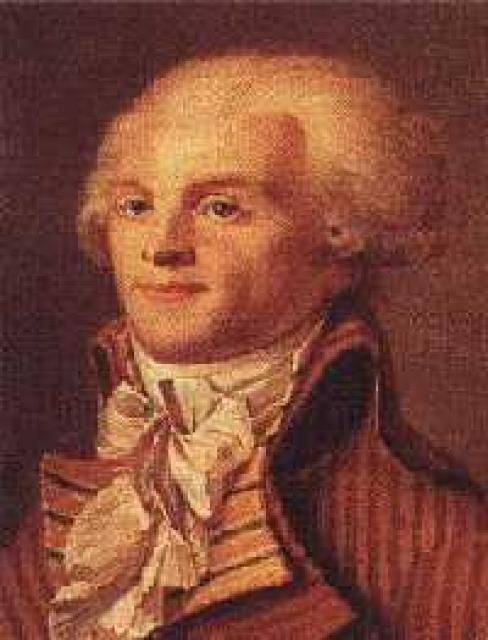
Maximilien Robiespierre
 France
Maximilien Robespierre: A Biography
Maximilien-Marie-Isidore Robespierre, a key figure in the French Revolution, was born on May 6, 1758, in Arras. He was a prominent leader of the Jacobins and played a significant role in the General Estates and later in the National Assembly (1789-1791). Robespierre held extremely left-wing positions and criticized the liberal majority of the Assembly for not being radical enough in their reforms.
Early Life and Education
Robespierre was born into a family of lawyers. His mother died when he was six years old, and his father left for abroad, leaving the children in the care of their relatives. From 1769 to 1781, Robespierre studied law at the College of Louis the Great in Paris. After completing his studies, he worked as a lawyer in Arras.
Political Career
In April 1789, Robespierre was elected as a deputy representing the Third Estate in the General Estates of France. He continued to hold extreme left-wing positions in the General Estates and later in the National Assembly. As a supporter of Rousseau, he criticized the liberal majority of the Assembly for their insufficient radicalism in implementing reforms.
Leadership and Popularity
Robespierre developed these same ideas from the tribune of the Jacobin Club, of which he became the leader. His speeches, characterized by democratic (and sometimes demagogic) rhetoric, earned him widespread popularity among the people and the nickname "The Incorruptible."
Revolutionary Government and Terror
After the dissolution of the National Assembly, Robespierre became the public prosecutor of the criminal court in Paris in October 1791, continuing his active political activities in the capital. In December 1791 and April 1792, he engaged in heated debates with the proponents of "exporting" the revolution in the Jacobin Club, urging the fight against "enemies of freedom" within the country. He wrote about the need for further revolution in the weekly publication "Defender of the Constitution" in the spring and summer of 1792.
In August 1792, during the uprising, the self-proclaimed Paris Commune included Robespierre among its members. In September, he was elected to the National Convention, where he, along with Jean-Paul Marat and Georges Danton, led the left-wing "Mountain" faction and engaged in a fierce struggle against the ruling Girondins (September 1792 - May 1793). Suspecting the Girondins of attempting to restore the monarchy, on December 3, 1792, Robespierre proposed the execution of Louis XVI without trial, and when the trial did take place, he voted for the king's death on January 15, 1793.
Robespierre entered the Committee of Public Safety on July 26, after the expulsion of the Girondins from the Convention due to the uprising from May 31 to June 2, 1793. Along with his followers, Louis Antoine de Saint-Just and Georges Couthon, he determined the overall political line of the revolutionary government and effectively led it. In November-December, he succeeded in halting the "dechristianization" carried out by the ultra-leftists (ebertists) and condemned their imposition of atheism. At the same time, he rejected the demands of Danton's supporters to end the revolutionary terror. In his programmatic speech on February 5, 1794, and subsequent speeches, Robespierre proclaimed the ultimate goal of the revolution to be the construction of a new society based on the Rousseauist principles of "republican morality," relying on an artificially created state religion - the cult of the Supreme Being. According to Robespierre, with the triumph of "republican virtue," all social problems would be solved. He considered terror to be the main means of achieving his ethical utopia.
Downfall and Execution
In March-April 1794, at the initiative of Robespierre and Saint-Just, the ebertists and dantonists were executed. In May-June, Robespierre inspired a nationwide campaign to promote the cult of the Supreme Being. On June 10, he and Couthon achieved the adoption of a law that introduced the death penalty for crimes against republican morality, and the accused were effectively deprived of the right to defend themselves. The "Great Terror," which began immediately after this, affected all social classes and undermined Robespierre's former popularity. His utopian ideals did not find support in society, and his dictatorial aspirations turned the majority of Convention deputies against him. On July 27 (Thermidor 9, according to the revolutionary calendar), the Convention decided to bring Robespierre and his supporters to trial. They attempted to organize resistance at the Paris City Hall but were captured by troops loyal to the Convention. The next day, they were executed.