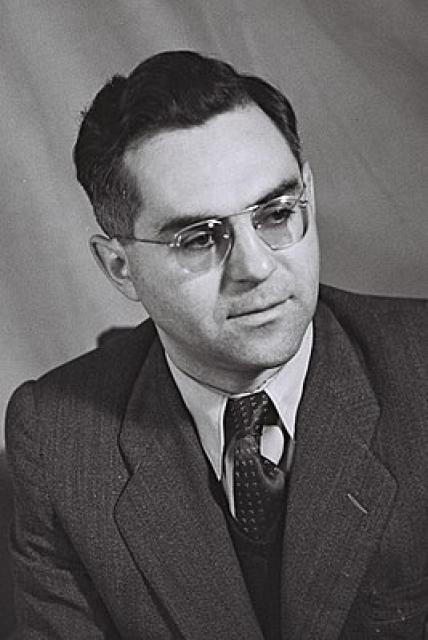
Meir Vilner
 Israel
- Early Life and Political Awakening
- Move to Palestine and Activism
- Independence and Knesset Membership
- Rakaḥ and Anti-Zionism
- Assassination Attempt and Hadash Alliance
- Retirement and Legacy
Early Life and Political Awakening
Meir Vilner was born into a socialist Zionist family in Vilnius, Lithuania. As a young man, he joined the socialist Zionist party "Hashomer Hatzair." However, as he grew disillusioned with the ideology of Zionism, he joined the Communist Party under the party pseudonym "Meir Vilner."
Move to Palestine and Activism
In 1938, Vilner moved to British Mandate Palestine. He witnessed the tragic events of the Holocaust, with most of his family perishing in Poland. He studied history at the Hebrew University of Jerusalem and joined the Palestinian Communist Party, which advocated for the rights of both Jews and Arabs. Vilner criticized British rule as well as the leadership of the Jewish community (Yishuv).
Independence and Knesset Membership
Despite his opposition to Zionist policies, Vilner supported the declaration of Israeli independence in 1948. At the age of 29, he became one of the 32 signatories to the Israeli Declaration of Independence. In 1949, he was elected to the Knesset as a member of the Communist Party of Israel (Maki). He served in the Knesset until 1959, briefly returning in 1961 before resigning again.
Rakaḥ and Anti-Zionism
In 1965, the Communist Party of Israel split, and Vilner formed the Rakaḥ (New Communist List) party with his supporters. Rakaḥ fully supported the anti-Israel policies of the Soviet Union and its leadership. Vilner led Rakaḥ into the Knesset in the 1965 elections.
Assassination Attempt and Hadash Alliance
After the 1967 Six-Day War, which Rakaḥ opposed, Vilner became the target of an assassination attempt by a member of the right-wing Gahal party. In the lead-up to the 1977 Knesset elections, Rakaḥ became part of the Hadash electoral alliance, and Vilner was re-elected as a member of Knesset.
Retirement and Legacy
Vilner retired from his position as General Secretary of the Communist Party of Israel in 1990 and left the Knesset. He had made a significant contribution to Israeli politics, advocating for the rights of minorities and opposing both British rule and the Israeli government's policies. Vilner received several awards from the Soviet Union, including the Order of the October Revolution and the Order of Friendship of Peoples.




