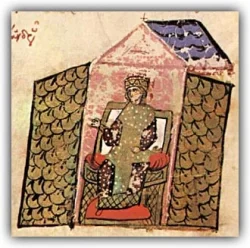
Michael III
Michael III ruled the Byzantine Empire from 842 to 867. He came to the throne as a child after the death of his father, Emperor Theophilos, and spent much of his reign navigating competing power centers at court. His period saw the final restoration of the veneration of icons, renewed military and cultural activity, and the start of a new dynasty after his violent death.
Child Emperor and Regency
Born in 840, Michael was the son of Theophilos and Empress Theodora. When Theophilos died in 842, Michael succeeded him while still an infant. His mother governed as regent with senior officials, including the eunuch Theoktistos and Theodora’s brother Bardas. In 843, the government formally restored the veneration of religious images, ending the second phase of Byzantine iconoclasm. This change was later commemorated in the Orthodox Church as the Feast of Orthodoxy.
Personal Rule and Imperial Affairs
Michael gradually took control of government. In 856, Bardas displaced Theodora’s regency and became the dominant figure at court, while Michael remained emperor. Under their rule, Constantinople experienced renewed attention to higher learning, including the school associated with the Magnaura palace. The period also saw the missions of the brothers Constantine, later known as Cyril, and Methodius among Slavic peoples, and the growing Christian influence of Byzantium in Bulgaria.
Military affairs remained difficult, particularly in the empire’s eastern provinces and around Sicily. Byzantine forces nevertheless achieved successes against Arab raiders, The reign’s military record was mixed, with setbacks and successes against Arab forces. Later dynastic histories often emphasized its defeats to diminish Michael’s standing.
Basil and the End of the Reign
Michael elevated Basil, a courtier of humble origins who rose to become his close associate, and crowned him co-emperor in 866. The partnership soon collapsed. Basil arranged the killing of Bardas in 866 and, in September 867, Michael was assassinated in his palace. Basil then became sole emperor, founding the Macedonian dynasty.
Legacy
Accounts written under Basil’s successors portrayed Michael as irresponsible and notorious for drinking. Historians treat such descriptions cautiously because the new dynasty had reason to discredit its predecessor. Michael’s reign is better understood through its substantial religious, diplomatic, and cultural developments as well as the instability of the court that ultimately cost him his life.