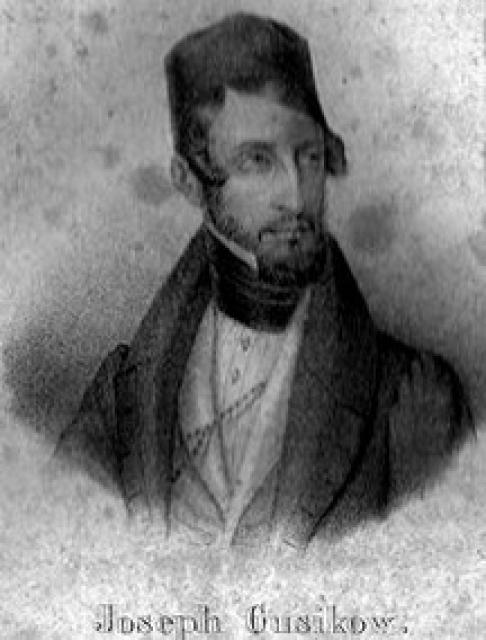
Michal Josef Gusikov
 Belarus
- Childhood and Early Career
- Health Challenges and a Turning Point
- Virtuoso on the Xylophone
- International Success
- Tragic End
- Legacy and Influence
- Recognition and Remembrance
Childhood and Early Career
Moses Guzikov was born into a modest Jewish family of klezmer musicians in Belarus. His musical journey began at a young age, as he excelled in playing the flute and dulcimer. As a child, he performed as a street musician, showcasing his exceptional talent.
Health Challenges and a Turning Point
Unfortunately, Guzikov's lung health deteriorated due to an illness, forcing him to abandon his aspirations as a wind instrument player. He turned his attention to a traditional instrument known as the "straw harmonica." His innovative spirit led him to modify this instrument, creating the modern four-row chromatic xylophone with a range of two and a half octaves.
Virtuoso on the Xylophone
Within three years, Guzikov mastered the xylophone, embarking on a remarkable solo career. His performances in Kiev, Moscow, and Odessa in 1834 captivated audiences. The following year, supported by renowned violinist Karol Lipiński and poet Alphonse de Lamartine, he embarked on a European tour, performing in Paris, Prague, Frankfurt, Vienna, and other major cities.
International Success
Guzikov's concerts were an overwhelming success. Dressed in traditional Jewish attire, he performed alongside an ensemble of family members. His repertoire included both traditional Jewish melodies and his own arrangements of classical masterpieces by Weber, Hummel, Paganini, and others.
Tragic End
Despite his incredible talent, Guzikov's career was cut short by his weakened health. He died of tuberculosis in Aachen, Germany, at the age of 31. His passing was a significant loss to the musical world, as he had revolutionized the xylophone.
Legacy and Influence
Guzikov's invention, the four-row chromatic xylophone, became the standard model for decades. He played a pivotal role in establishing the xylophone as a legitimate instrument in classical music. Guzikov's virtuoso performances left an enduring impression on renowned musicians of his time, including Felix Mendelssohn and Ferdinand Hiller.
Recognition and Remembrance
Musicographer François-Joseph Fétis wrote an extensive article on Guzikov in his esteemed work, "Biographie Universelle des Musiciens." While Guzikov's original compositions have not survived, his legacy lives on as a pioneer in the development of the xylophone, inspiring generations of musicians to come.