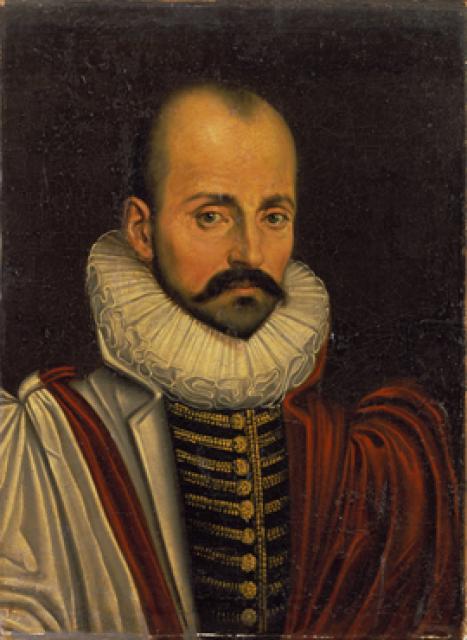
Michel Eyquem De Montaig
 France
- Biography of Michel Eyquem de Montaigne
- Early Life and Education
- Political Career and Philosophical Views
- Personal Life and Literature
- Essays and Later Life
- Later Years and Legacy
Biography of Michel Eyquem de Montaigne
Michel Eyquem de Montaigne was a renowned French writer and philosopher of the Renaissance era. He was born on February 28, 1533 in Bordeaux, France. His father, Pierre Eyquem, belonged to the upper-middle class, while his mother was a wealthy heiress from a Jewish family that had migrated to France from Spain or Portugal.
Early Life and Education
During his early childhood, Montaigne was raised according to his father's pedagogical method, which was similar to the views on education held by François Rabelais. Montaigne's tutor only spoke Latin and conversed with him exclusively in this language. At the age of 6, Montaigne was sent to school, and at 21, after studying ancient authors, philosophy, and law at the University of Toulouse, he obtained a judicial position. He soon became friends with his colleague Étienne de La Boétie, who would remain the closest person to him throughout his life. La Boétie's early death in 1563 deeply affected Montaigne.
Political Career and Philosophical Views
For a time, Montaigne was driven by political ambition. During this period, France was embroiled in religious wars, and although Montaigne aligned himself with the Catholic side, he was inclined towards religious tolerance due to his character and life experiences. Many of his close relatives and friends were Huguenots, and he himself considered religious compromise at one point. However, he later concluded that it was impossible to accept certain aspects of Catholic doctrine while rejecting others, as church teachings formed a unified whole.
Personal Life and Literature
In 1565, Montaigne married Françoise de la Chassaigne, who brought him a substantial dowry. After his father's death in 1568, he inherited the ancestral estate of Montaigne. In 1571, he settled there, sold his judicial position, and retired. His first literary work was a translation of a Latin treatise by the Spanish theologian Raymond Sebond, who sought to provide evidence for the truth of the Catholic faith through arguments of human and natural reason. This approach contradicted Montaigne's belief that faith lies beyond and above reason. Montaigne's extensive essay, "An Apology for Raymond Sebond," analyzes Sebond's views and presents Montaigne's own important thoughts on religion. He began working on this essay seven years after publishing the translation.
Essays and Later Life
Montaigne's earliest essays date back to 1572, during the time of the St. Bartholomew's Day massacre and the start of the civil war. Initially, these were just notes on his readings. Montaigne's favorite books at the time included Seneca's letters, Plutarch in Jean Amyot's French translation, Latin poets, and several contemporary historical and memoir writings. Montaigne was particularly interested in topics such as governance, war, and human behavior. Travel accounts also captured his attention, and one of his essays, "Of Cannibals," is based on such an account, in which he develops the idea of the "noble savage" two centuries before Jean-Jacques Rousseau. The first two books of his Essays were published in 1580 in Bordeaux. In these early writings, personal themes gradually gave way to more general and literary questions. In 1577, Montaigne experienced his first bout of kidney stones, and three years later, he traveled to Germany and Italy for treatment. The result of this journey was his "Journal de Voyage" or Travel Journal.
Meanwhile, Montaigne was re-elected as the mayor of Bordeaux. During his second term, civil war resumed, and the city was visited by the heir to the throne, Henry of Navarre. Montaigne received the prince and gained his favor. However, he had already lost his political ambition by this time and sought solitude in his castle. His thoughts were occupied by the work on the third book of Essays. The third book and the additions Montaigne made to the first two primarily have an autobiographical character. He was most interested in his own experience, not because it seemed unique to him, but because it was the only evidence he could rely on.
Later Years and Legacy
In 1588, Montaigne met Marie de Gournay, a young admirer of his ideas, in Paris. She became his adopted daughter and published a posthumous edition of his Essays in 1595. In his final years, Montaigne suffered from various illnesses, including kidney stones, gout, and rheumatism. Even before reaching the age of sixty, he felt like an old man. Despite his ailments, he tried to maintain an active lifestyle. However, he declined an invitation from Henry IV to visit him in 1590. Montaigne passed away on September 13, 1592.
Montaigne's Essays consist of examinations and experiments in which he subjects his own opinions on various topics to scrutiny. Education, friendship, parental love, freedom of conscience, and self-control are all considered from the perspective of personal experience and supported by quotations. Montaigne concludes that everything is relative.
During his lifetime, Montaigne enjoyed popularity that lasted for over half a century after his death. His works were translated into English by John Florio in 1613, and it is possible that Shakespeare was familiar with them ten years prior to this translation. Montaigne's religious views were later condemned by the Church, and his popularity declined. However, he remained a favorite author for libertines and influenced thinkers like Blaise Pascal, who debated with Montaigne's rationality throughout his life. Even during the period when interest in Montaigne waned between 1669 and 1724, he still had admirers such as Jean de La Bruyère. In the 18th century, Montaigne's ideas were reevaluated, and in the 19th century, his subtle psychological reasoning was appreciated.


