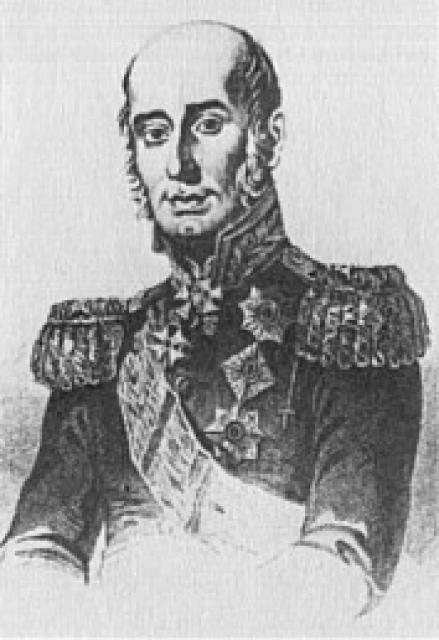
Mihail Barklay-de-Tolli
 Russia
- Michael Andreas Barclay de Tolly: A Remarkable Military Leader
- Military Education and Advancement
- Combat Experience and Awards
- Under the Reign of Paul I and Alexander I
- War with Napoleon and Strategic Leadership
- The Invasion of Russia
- Later Career and Honors
- Legacy
Michael Andreas Barclay de Tolly: A Remarkable Military Leader
Early Life and Military BeginningsMichael Andreas Barclay de Tolly was born on December 13, 1761, in the manor of Pamusisse in Livonia, to a wealthy but noble family. His father, Weinhhold Gottard Barclay de Tolly, came from an ancient Scottish clan that had emigrated to Riga in the 17th century. After joining the Russian army, he briefly served as a lieutenant before retiring.
Military Education and Advancement
Barclay's early education took place in Saint Petersburg, where he resided with his mother's family. At six years old, he enrolled in the Novotroitsk Cuirassier Regiment as a corporal-sergeant. While simultaneously pursuing his education, he continued to rise through the ranks, becoming a sergeant-major in 1769 and a cornet in 1778.
Barclay's intelligence and dedication earned him recognition from General-Major Reinhold Ludwig von Patkul, who promoted him to second lieutenant in 1783. He later became an adjutant to the Prince of Anhalt-Bernburg-Schaumburg-Hoym, who promoted him to captain.
Combat Experience and Awards
Barclay gained his combat experience during the Russo-Turkish War of 1787-1791. Serving under Prince Anhalt-Bernburg, he participated in the storming of Ochakov and Akkerman, receiving the Order of Saint Vladimir, 4th Class, for his bravery.
He also fought with distinction in the Russo-Swedish War of 1790, where he was wounded and decorated with the Order of Saint George, 4th Class. His exemplary leadership earned him further promotions and appointment as commander of the 1st Battalion of the Estonian Jaeger Corps.
Under the Reign of Paul I and Alexander I
Under Emperor Paul I, Barclay rose to the rank of colonel and became chief of the 4th Jaeger Regiment. In 1799, he was promoted to major general for his exceptional training of the regiment.
With Alexander I's accession to the throne, Barclay became involved in military reforms and was appointed chief of the 6th Infantry Division in 1807. He played a crucial role in the planning and execution of the successful invasion of Finland in 1808, earning the Order of Saint Alexander Nevsky.
War with Napoleon and Strategic Leadership
As tensions with France rose, Barclay became War Minister in 1810. He strengthened the army's defenses, increased recruitment, and reorganized the War Ministry. He also formulated a comprehensive strategy to counter Napoleon's invasion, emphasizing strategic retreat to exhaust and cut off enemy supply lines.
The Invasion of Russia
When Napoleon invaded Russia in 1812, Barclay commanded the 1st Western Army. He skillfully coordinated his retreat with Bagration's 2nd Western Army, keeping Napoleon's forces at bay. However, his defensive strategy drew criticism from many generals, who demanded a decisive battle.
After the retreat from Smolensk, Alexander I replaced Barclay with Mikhail Kutuzov as Commander-in-Chief. Nevertheless, Barclay remained a key figure in the war effort, commanding the 1st Army at the Battle of Borodino.
Later Career and Honors
After the war, Barclay returned to Saint Petersburg and resumed his duties as War Minister. In 1814, he commanded the Russian troops that entered Paris after Napoleon's defeat. For his service, he was elevated to the rank of Prince in 1815.
Legacy
Michael Andreas Barclay de Tolly's strategic leadership and military prowess played a pivotal role in the Russian victory over Napoleon. His legacy as a skilled and innovative military commander continues to inspire and be studied by strategists and historians alike.


