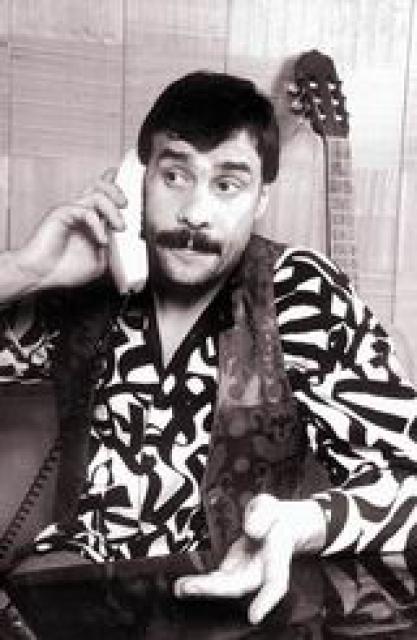
Mihail Kochetkov
 Russia
Biography of Mikhail Kochetkov
Mikhail Kochetkov is a Russian poet, songwriter, and bard. According to his colleagues and fans, Kochetkov's poems occupy a vast space between Galich and Brodsky. In his songs, he depicts the poeticism of urban life and the fallen heroes who live in a world where "all the furniture is four glasses, an old table, and a lame bed." Kochetkov himself possesses a hypnotic charm and a powerful positive aura.
Kochetkov gained popularity as the host of "Gnezdo Glukharya" (The Nest of the Capercaillie), a morning show on the Russian TV channel, where he enchanted the audience with his shy boyish smile and villainous mustache, along with his lyrical gaze and husky ironic baritone.
Meeting with the Legendary Capercaillie
During an interview with "Alef," the legendary Capercaillie bard, Mikhail Kochetkov, shared his thoughts on his creative work. According to his colleagues and fans, Kochetkov's poems occupy a vast space between Galich and Brodsky. In his songs, he depicts the poeticism of urban life and the fallen heroes who live in a world where "all the furniture is four glasses, an old table, and a lame bed." Kochetkov himself possesses a hypnotic charm and a powerful positive aura.
As the interview began, Kochetkov welcomed the interviewer, mentioning that his two long-eared dachshunds, Zama and Tsilya, were friendly and that the stuffed bird in the room was his trophy, which he shot himself. The interview took place at the Bard Cafe "Gnezdo Glukharya" on Nikitskaya Street. While Kochetkov examined the rare feathered exhibit, his dogs sniffed the interviewer's shoes, and Kochetkov prepared tea.
Kochetkov mentioned that he had just returned from London and had brought a souvenir t-shirt with cannabis leaves on it, revealing his humorous side. He explained that he stumbled upon a rather "druggy" shop on the outskirts of London and decided to buy unconventional souvenirs. However, he assured the interviewer that he did not go to London specifically for these items but rather to perform songs.
When asked about performing in London, Kochetkov confirmed that Russian bards were indeed appreciated there. He had two concerts, and the audience consisted of Russian speakers who genuinely understood his songs. From the two hundred thousand Russians living in England, these were the most devoted fans.
The interviewer wondered where it was better to perform, in Russia or abroad. Kochetkov admitted that Russia still held a special place for bardic performances. He mentioned the difficulty for an Englishman to understand the Russian slang present in his songs, which often resonated more with Russian audiences. He quoted his lyrics: "I became harmful and petty, deaf to both ears, no longer drawn to girls, especially old ones. My years pass under the maid's staircase. It's high time to hang myself, but my hands can't reach it." He believed that these lines would be better understood in Russia.
The interviewer inquired about Kochetkov's long-standing romance with author songs. Kochetkov revealed that he had been enamored with author songs since childhood. He recalled composing his first poems in kindergarten and still remembered them vividly. He mentioned his self-confidence as a driving force for his writing, leading him to take pride in his work.
Kochetkov was then asked about reviving the old TV project "Gnezdo Glukharya," which had once enjoyed high ratings. However, Kochetkov admitted that he had no desire to revive the show. He found the experience of hosting the show to be challenging, as it hindered his songwriting. He felt that he had lost more than gained during that period and was still recovering. Instead, he focused on his new songs, having recently released a twelve-song album.
When asked about the dominance of chanson music over author songs, Kochetkov mentioned that in the original plan for the Bard Cafe "Gnezdo Glukharya," there was intended to be a separate hall for chanson singers. However, the idea did not materialize, as different genres attracted different audiences. Kochetkov believed that the Russian people were attached to the criminal lyrics of chanson songs due to personal connections with the criminal world. He acknowledged that the chanson genre had evolved from marginal folklore to a mainstream music style with increased exposure on the radio. Nevertheless, he emphasized the difference in quality between chanson hits and the songs of renowned authors like Mityaev, Mitiaeva, Vysotsky, and Galich.
The interviewer asked Kochetkov to define the criteria for quality in author songs, to which he responded that it was the spine-tingling sensation one feels while listening. He referred to Vladimir Nabokov's description of the "sacred shiver along the spine." However, Kochetkov also acknowledged that the listener must be discerning and not merely consume music mindlessly.
The interview concluded with a question about the commercialization of the Club of Amateur Song (KSP). Kochetkov explained that the commercialization was not specific to KSP but rather a reality in all aspects of life. He cited corporate sponsorships of symphony concerts as an example. He believed that certain genres could not survive without financial support, which used to come from the state and now relies on a few generous sponsors. Kochetkov also recognized the role of successful businessmen within KSP, whose support enables other artists to perform in cities like Omsk or Donetsk, where ticket prices cannot match those in Moscow.
In summary, Kochetkov expressed his love for songwriting and the joy it brings him. He reflected on his experiences and the transformations he has witnessed in Russia throughout his life. Despite facing personal setbacks, he considered himself incredibly happy. Kochetkov shared a poignant poem about his late grandfather, a sailor who dreamed of adventures at sea, which emphasized the importance of dreams and the passage of time.