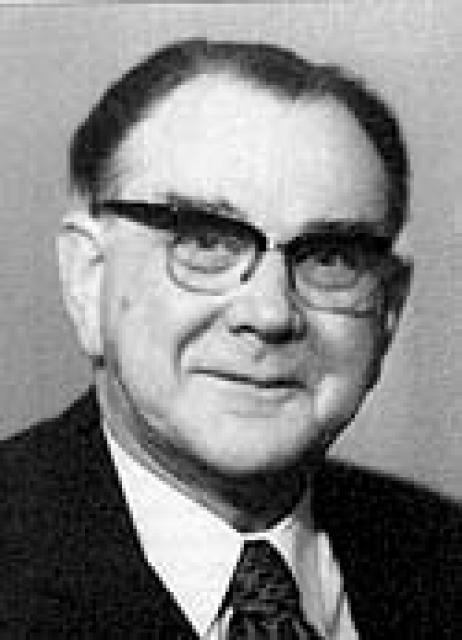
Mihail Riazanskiy
 Russia
- Early Life and Education
- Niizhny Novgorod Radio Laboratory
- False Accusations and Redemption
- Higher Education and Health Challenges
- Ostechburo and Research
- Radar and Post-War Research
- Administrative Role and Scientific Achievements
- Later Years and Legacy
Early Life and Education
Mikhail Sergeyevich Ryazansky was born in Saint Petersburg in 1909. He spent his childhood in Baku, where his father worked for the Nobel Company. In 1923, the Ryazansky family moved to Moscow.
From an early age, Mikhail exhibited a keen interest in radio and an active nature. He became a Komsomol member and engaged in propaganda work. He also secured a job as a technician and later as a foreman.
In the mid-1920s, Ryazansky devoted himself to amateur radio, leading radio circles and working in various organizations related to the field. His achievements included establishing the first radio contact with the icebreaker "Krasin" in 1928, an accomplishment he cherished throughout his life.
Niizhny Novgorod Radio Laboratory
Ryazansky's reputation within the radio community led to a recommendation for a position at the prestigious Nizhny Novgorod Radio Laboratory in 1928. There, he became head of the antenna testing ground and continued his Komsomol activities as secretary of the laboratory's organization.
False Accusations and Redemption
During his time at the laboratory, Ryazansky faced a potentially devastating accusation of arson. However, the laboratory's youth rallied in his defense, and he escaped with only a month of forced labor. Nonetheless, the accusation and the stigma of having a priest as a grandfather haunted him throughout his life.
Despite these setbacks, Ryazansky remained determined to pursue his passion for radio engineering. He designed his first radio stations, some of which were adopted by the Red Army.
Higher Education and Health Challenges
In 1931, Ryazansky was directed to pursue higher education at the Leningrad Military-Technical Academy. However, when admission was not available, he enrolled at the Leningrad Electrotechnical Institute. Simultaneously, he worked at the Special Technical Bureau (Ostechburo), developing radio receivers for the Soviet Navy.
The combined workload and health issues, including tuberculosis, took their toll on Ryazansky. Advised by doctors that he would die if he remained in Leningrad, he relocated to Bashkiria, where his family had settled. With his parents' care, he gradually recovered.
Ostechburo and Research
In 1934, Ryazansky returned to Moscow and transferred to the Moscow Electrotechnical Institute (MEI). He worked at Ostechburo's Moscow branch and completed his MEI degree in 1935 with a secret thesis on specialized radio systems.
After graduation, Ryazansky continued at Ostechburo, which evolved into the Scientific Research Institute No. 20 (NII-20). There, he focused on remote control systems for aircraft, torpedo boats, tanks, and other military equipment.
Radar and Post-War Research
Just before the outbreak of World War II, Ryazansky became involved in radar development. He participated in the creation of the first Soviet radar, P-2, and developed the receiver. Despite wartime conditions, the radar was completed in record time, earning its developers, including Ryazansky, the 1943 Stalin Prize.
After the war, Ryazansky delved into the study of radio guidance systems for the German V-2 rocket. He traveled to Germany in 1945-1946 as part of a Soviet team studying German engineering. There, he gained valuable experience in the field.
Upon his return to the Soviet Union, Ryazansky became Chief Designer of NII-885, specializing in radio equipment and communication systems for rockets. He held this position for the remainder of his life.
Administrative Role and Scientific Achievements
In January 1951, Ryazansky was appointed Chief Engineer of NII-88 and later, in 1952, Head of the Main Administration of the Ministry of Armaments of the USSR. Although he found ministerial work somewhat unfulfilling, it provided him with invaluable insights into the bureaucratic machinery.
In 1954, Ryazansky returned to NII-885 as Scientific Director and Chief Designer until his death. He contributed to the development of radio systems for ballistic missiles, space launchers, satellites, and interplanetary probes.
He became a member of the renowned Council of Chief Designers founded by Sergei Korolev. In 1956, he received the Hero of Socialist Labor for his role in developing the R-5 missile and in 1957, the Lenin Prize. He was elected Corresponding Member of the USSR Academy of Sciences in 1958 for his contributions to the creation of the first Earth satellites.
Later Years and Legacy
In his later years, Ryazansky faced personal tragedy with the loss of his wife and son. He immersed himself in work, developing equipment for obtaining television panoramas of Mars and Venus. However, his health deteriorated, and he passed away in 1987.
Mikhail Sergeyevich Ryazansky left behind a legacy as a pioneering Soviet engineer and scientist who played a pivotal role in the development of the country's rocket and space program.