Mihail Turovskiy
 USA
USABiography of Mikhail Turovsky
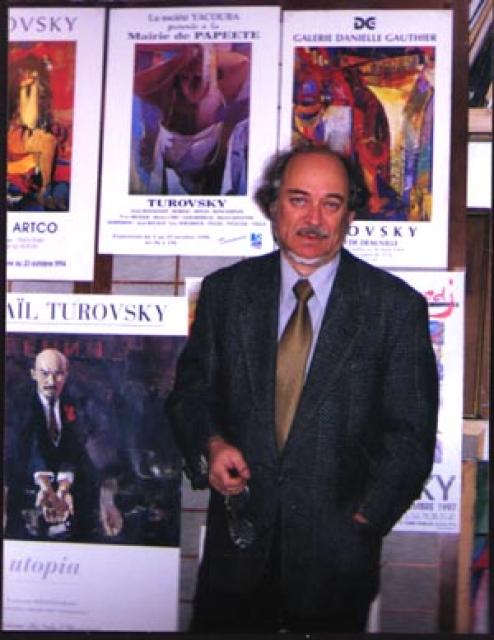
Mikhail Turovsky is a renowned New York artist known for his prolific body of work. His studio in Upper Manhattan is brimming with paintings, giving the impression that he works tirelessly, almost without sleep. Turovsky is not only a talented artist, but also a philosopher, scholar, and writer. His insightful musings and witty humor have been published in various publications, making him a respected figure in the art world.
Turovsky's artwork can be found in galleries and collections all around the world. His unique style and profound understanding of the human condition have captivated audiences and critics alike. His book of drawings and aphorisms, "The Itch of Wisdom," quickly gained popularity and has become a bibliographic rarity.
Aside from his artistic pursuits, Turovsky is known for his warm and friendly demeanor. His piercing blue eyes attentively observe and absorb every thought that crosses his path. He believes in experiencing all that life has to offer and cherishes the opportunity to delve into various aspects of human existence.
Turovsky's biography is filled with intriguing anecdotes and encounters. During his time as a member of the Union of Artists in the USSR, he recalls a dramatic episode at the House of Artists. Sitting at the entrance was a man who distributed keys, a former runaway. This man, with his curious gaze reminiscent of Bashmachkin's eyes, touched Turovsky's sleeve and remarked, "You live your life, but you will never experience such a thing," referring to Turovsky's worn-out jacket. This encounter left a lasting impression on Turovsky, highlighting the deeply ingrained attachment Russians have to their material possessions.
In contrast, Turovsky muses on the more democratic relationship Americans have with their belongings. He observes that Americans are more willing to let go of material possessions because their main focus is success and work. If success and work can be found elsewhere, they are willing to leave everything behind. Turovsky admires this freedom, but acknowledges that Russians hold sentimental value to their belongings, viewing them as sacred. However, when it comes to immovable property, the story changes, and ownership becomes a significant factor for both Jews and non-Jews.
Turovsky also discusses the intersection of art and literature, noting that many great artists throughout history have been exceptional wordsmiths as well. He believes that no art critic can match the artistic insight of an artist. Turovsky cites Michelangelo as an example, who beautifully expressed his artistic perception through his poetry. Similarly, he praises Vincent van Gogh's letters as an invaluable insight into his art. Turovsky describes his own emotional reaction to Van Gogh's painting "Landscape in Overveen after Rain," noting that it moved him to tears and left a lasting impact on his artistic sensibilities.
The artist also reflects on the literary talents of Ilya Repin, Auguste Rodin, and Salvador Dali. While Repin's book "The Near and the Far" lacks artistic insights, it offers poignant observations on people, events, and nature. Rodin's thoughts were recorded by those around him, with Rainer Maria Rilke serving as his most prolific scribe. Dali's writings, on the other hand, reveal his deep connection to his dreams and the surreal world.
Turovsky also discusses the popularity of Anton Chekhov's works in America and England, suggesting that Chekhov's ideas of solitude, indecision, and introspection resonate with Western audiences who embody practicality and determination. The absence of these qualities in Chekhov's characters makes them even more intriguing to Western readers.
When it comes to his own literary endeavors, Turovsky aims to translate his relationship with art and painting into verbal expressions of aphorisms. He seeks to create poetic formulations that convey the artist's intentions. Turovsky's passion for writing led him to publish a collection of aphorisms in New York, a decade after his book proposal was rejected by a Russian publisher.
Throughout his career, Turovsky experienced the support and influence of various patrons. From the Medici family in Italy to the Russian czars, from the industrialists Savva Mamontov and Ivan Morozov to the sugar factory owners Ivan Tereshchenko and Nikolai Sochenko, these patrons played a crucial role in fostering artistic development and creating art collections.
Today, Mikhail Turovsky continues to create thought-provoking artwork that explores the complexities of the human experience. His contributions to the art world, both as a painter and a writer, have solidified his place among the great artists of our time.


