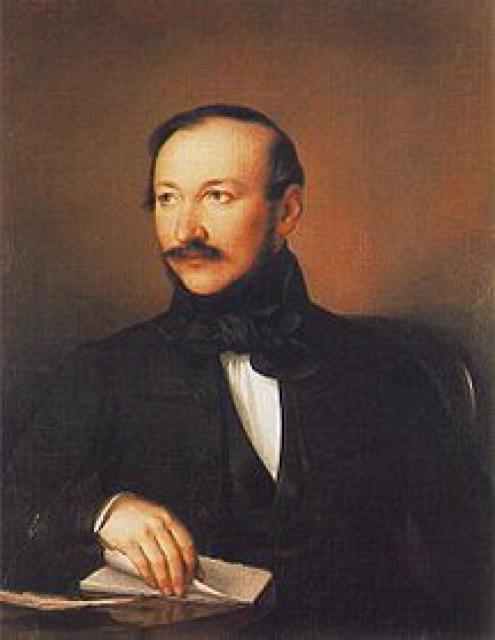
Mihaly Vorosmarty
 Hungary
- Early Life and Education
- Romantic and Patriotic Themes
- Literary Career and Struggle
- Dramas and Poetry
- Revolution and Exile
- Legacy
Early Life and Education
Mihaly Vorosmarty, a renowned Hungarian poet, writer, and translator, was born into a noble Catholic family in 1800. Despite his father's position as a manager for the Nadasdi family, the family faced financial hardship after his untimely death in 1811. Vorosmarty received his education at the Cistercian school in Szekesfehervar and the Piarist school in Pest.
Romantic and Patriotic Themes
Vorosmarty's unrequited love for Etelka Perszel, a member of a higher social class, inspired his celebrated romantic lyric poetry. His patriotic fervor manifested in the epic poem "Zalán's Flight" (1824), a masterpiece of Hungarian literature. This work marked Vorosmarty's transition from classical to romantic style, earning him recognition among Hungarian Romantics.
Literary Career and Struggle
Despite his acclaim, Vorosmarty's financial situation remained precarious. He abandoned law and devoted himself to literature full-time, but faced harsh criticism. Vorosmarty penned four dramas and eight short novels between 1823 and 1831. In 1830, he joined the Hungarian Academy of Sciences and later became its director. He was involved in founding the Kisfaludy Society and launching literary journals such as "Athenaeum" and "Figyelmező."
Dramas and Poetry
Vorosmarty's greatest dramatic achievement, "Bloody Wedding" (1833), won him an academy prize. His collections of poetry included the patriotic hymn "Appeal" (1826), "The Abandoned Mother" (1837), and "To the Noble Lady" (1841). After his marriage in 1843, he wrote a cycle of erotic lyrics.
Revolution and Exile
During the 1848 Hungarian Revolution, Vorosmarty collaborated on translating Shakespeare's works. After the revolution's defeat, he spent time in exile and returned to Hungary in 1850, a broken man. Deeply melancholic, he wrote his last major poem, "The Old Gypsy" (1854), before his death in 1855. His funeral was observed as a national day of mourning.
Legacy
Vorosmarty's most famous poem, "Appeal," is set to music and often performed at national celebrations in Hungary. Budapest's central square, Vorosmarty Square, bears his name, honoring his enduring contributions to Hungarian literature.


