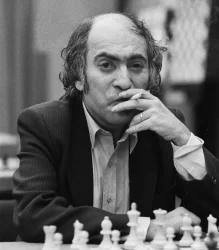
Mikhail Botvinnik
- From Kuokkala to the Soviet elite
- Three reigns as world champion
- The engineer and the teacher
- A legacy beyond the board
Mikhail Botvinnik combined a world champion’s competitive instincts with an engineer’s belief in preparation. He held chess’s highest title across three separate reigns, helped establish the Soviet Union as a dominant force in international chess, and later trained young players who would shape the game’s next generation. His influence came not only from victories, but from the systematic way he studied and taught chess.
From Kuokkala to the Soviet elite
Botvinnik was born on 17 August 1911 in Kuokkala, then part of the Grand Duchy of Finland within the Russian Empire. He learned chess as a boy and quickly became one of the strongest young players in Leningrad. In 1931, at age 20, he won the Soviet Championship, a breakthrough that began a long career at the top of Soviet and international chess.
He studied electrical engineering alongside chess and approached the game analytically. Botvinnik prepared openings carefully, investigated positions after his games, and treated physical fitness and concentration as parts of competitive performance. He won the Soviet championship six times and became an international grandmaster in 1950.
Three reigns as world champion
After reigning champion Alexander Alekhine died in 1946, the world title was decided through a tournament rather than a one-on-one match. Botvinnik won the 1948 championship tournament and became the sixth official World Chess Champion. He defended the title against David Bronstein in 1951 and Vasily Smyslov in 1954, both matches ending in draws that allowed him to retain the crown.
Smyslov finally defeated him in 1957, but Botvinnik used the rematch right then available to former champions and regained the title in 1958. Mikhail Tal beat him in 1960; Botvinnik returned again to win their 1961 rematch. In 1963, Tigran Petrosian defeated him, and FIDE had ended the automatic rematch privilege. Botvinnik chose not to enter the next championship cycle, bringing his era as a contender for the title to a close.
The engineer and the teacher
Botvinnik continued to work in engineering and became an early researcher in computer chess. He explored how a program might imitate a human master’s selective analysis rather than simply calculate every possible move. This interest in method and disciplined thought was also central to his teaching.
His Moscow chess school trained many leading Soviet players, including future world champions Anatoly Karpov and Garry Kasparov. Botvinnik urged students to analyze their own games, build reliable opening preparation and understand the logic behind a position instead of relying on memorized patterns. The school helped make systematic training a lasting part of elite chess.
A legacy beyond the board
Botvinnik retired from top-level competitive play in 1970 but remained active in chess research and education. He died in Moscow on 5 May 1995, aged 83.
Remembered as the “Patriarch of Soviet Chess,” Botvinnik helped shape both the competitive culture and the intellectual study of the game. His record of losing the title and winning it back twice showcased extraordinary resilience; his school and writings ensured that his approach continued to influence players long after his own championship reign ended.