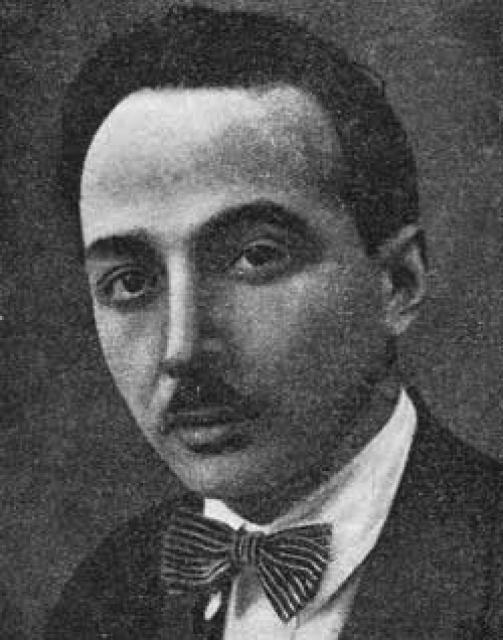
Mikhail Kozakov
- Early Life and Education
- Revolutionary Years and Literary Beginnings
- Journalistic and Literary Career
- Literary Group and Early Works
- Works in the 1930s
- Playwright and Theatre
- Legacy and Impact
Early Life and Education
Mikhail Emmanuilovich Kozakov was born on a railway station in what is now Ukraine in 1897. His Jewish family moved to Crimea during his childhood, where his father worked as a weigher at the port. Kozakov completed his secondary education in 1916 at a gymnasium in Lubny. He briefly studied medicine and law at the University of Kiev.
Revolutionary Years and Literary Beginnings
In January 1919, Kozakov was appointed Labor Commissioner in Lubny, where his mother resided. He also became involved in journalism as a member of the editorial board of the local newspaper "Izvestia" and a correspondent for the telegraph agency ROSTA. During the advance of Denikin's army, Kozakov was responsible for evacuating civilians. He accompanied them to Kazan, where he resumed his studies at the local university in 1920.
Journalistic and Literary Career
Kozakov moved to Petrograd in 1921 and graduated from the law faculty of the university in 1922. He began his writing career as a journalist and published his first stories in 1923. His debut collection of stories, "Popugaievo Schastie," was published in 1924, showcasing his experimental narrative techniques and use of metaphors. Kozakov was criticized for "formalism" in his writing.
Literary Group and Early Works
In the 1920s, Kozakov belonged to the literary group "Sodruzhestvo." During this period, he published the novellas "Meshchanin Adameiko" (1927) and "Poltora Hama" (1927), as well as the novel "Chelovek, Padayushchiy Nitsem" (1929).
Works in the 1930s
In the 1930s, Kozakov became the editor-in-chief of the journal "Literaturny Sovremennik." He was also a staff member of the newspaper "Literaturny Leningrad." In 1932, he wrote the screenplay for the film "Blestiaschaya Karera." Kozakov also contributed to the book "Kanal Imeni Stalina" (1934).
Playwright and Theatre
Kozakov wrote around 10 plays, including "Kogda Ya Odin" (1934), "Chekisty" (1939), "Darya" (1942), and "Zhavoronok Poyet" (1943). His play "Zolotoy Obruch" (1945), co-written with Anatoly Mariengof, marked the opening of the Moscow Drama Theatre on Malaya Bronnaya in 1946.
Legacy and Impact
Kozakov's work reflects the social and political turmoil of the times he lived in. He experimented with narrative techniques and explored controversial themes, such as antisemitism. Although some of his plays were banned, others were highly acclaimed and continue to be performed.


