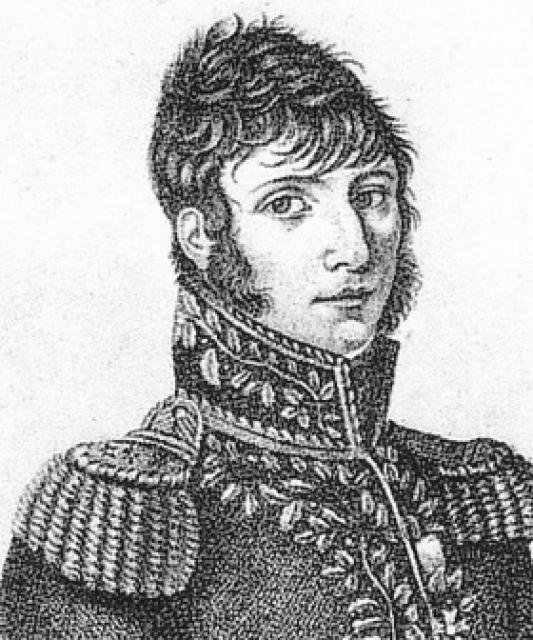
Mishele Claparede
 France
Biography of Michel Claparede
Early Life and Military CareerMichel Marie Claparede was born on August 28, 1770, in Ainac, Ariège. He began his military career on February 1, 1793, as a soldier in the 4th Battalion of Volunteers of the Department of Ariège, and just four days later, he was elected captain. From March 1793, his battalion became part of the Coastal Army. In May-September 1793, he served in the garrison of Belle-Île, and from September 1793, he joined the Army of the Brest Coast. On November 22, 1793, he was elected lieutenant colonel and commander of his battalion, but in March 1794, he became a captain again. In 1794-1795, he fought in the Army of Cherbourg, and from January 1796, he served in the Army of the Oceanic Coast. On July 25, 1796, he was transferred to the army as a captain in the 23rd Light Regiment. From January 1798, he fought as part of the Italian Army. On May 10, 1799, he was transferred to the General Staff and the next day he was appointed commander of the fortifications of Genoa. In August 22, he resigned from his position and returned to being commander of a battalion in the 23rd Light Regiment. He served in the Rhine Army and participated in battles at Messkirch, Bibersbach, Hochstädt, and Goggingen. On May 9, 1801, he was transferred to General Lecourbe's observation corps in Gironde, and on October 28, he joined the General Staff of the expeditionary corps sent to Santo Domingo. On August 2, 1802, he was promoted to brigadier general by Lecourbe (confirmed on November 27, 1802). From December 1, 1802, he was part of General Clozel's division. In January 1804, he returned to France but was soon sent back to the colonies and participated in battles in the Antilles. In June 1805, he joined General Udino's Grenadier Reserve. He fought in the vanguard of the corps at Wertingen, Ulm, Hollabrunn, Znaim, Jena, Prentzlau, Ostrolenka, and was injured in the battle of Pultusk. He was noticed and favored by Napoleon. During the meeting of the Russian and French emperors in Erfurt in October 1808, he commanded the French infantry stationed there. From September 1808, he fought in Spain. On January 11, 1809, he became the governor of the province of Valladolid, and on January 15, he also became the commander of Udino's reserve corps. From April 9, 1809, he was the commander of the 1st Division of Udino's corps. He took part in battles at Landshut, Passau, and Essling. He became famous for his actions in the Battle of Ebersberg (1809), where, with only 7,000 soldiers, he held off over 30,000 Austrians for three hours. From June 30, 1809, he commanded the 1st Division of the army in Dalmatia and participated in the battles at Wagram and Znaim. From July 17, he commanded the 1st Division of Marshal Marmont's 11th Corps, which was part of the Army of Germany. In October 1809, he commanded the troops in Laibach and the 1st military district of the Illyrian Provinces. On August 28, 1810, he was appointed commander of the 2nd (from September 10, the 1st) Division of the 9th Corps in Bayonne. From October 26, he served as the commander of the stationary troops in Salamanca and Zamora, as well as in the positions of Ciudad Rodrigo and Alba. On February 18, 1811, he defeated the forces of English General Trent at Covião. From April 9, 1811, he became the commander of the 2nd Division of the 5th Corps of the Spanish Army, which operated in Extremadura. In February 1812, he was transferred to Dalmatia and Ragusa, and on February 21, he joined the Grand Army. On March 8, Claparede was entrusted with the command of the Polish Vistula Legion, which was part of the French army. On April 2, 1812, his legion, with the addition of several other units, was transformed into a division within the Imperial Guard. Claparede's division fought bravely at the Battle of Borodino, Mozhaysk, Vinkovo, Krasnoye, and the crossing of the Berezina. From June 25, 1813, he commanded the 43rd Infantry Division in Marshal Oudinot's observation corps. From August 7, he served as the commander of a division in the 14th Corps of Marshal Louis-Gabriel Suchet. He was wounded in the battle of Gisshübel on August 22, 1813. Along with the rest of the French army, he surrendered on November 11, 1813, in Dresden. On June 1, 1814, he was released and returned to France. He was praised by the Bourbons, and on July 23, he was appointed as the prestigious position of governor of the 1st military district (Paris). When news of Napoleon's return to France became known, Claparede was appointed commander of the 4th Division in the royal army of the Duke of Berry. During the Hundred Days, he remained loyal to the Bourbons and on July 15, he became the commander of the garrisons in Paris and on the Seine. From October 15, he was also in charge of the 2nd military district of Châlons-sur-Marne. In November 1815, he was part of the commission established to judge Marshal Ney. On June 23, 1816, he was granted the title of Count. Later, he held high administrative positions in the royal army, and on March 5, 1819, he became a member of the French peerage. After the July Revolution of 1830, he, along with other royal generals, lost his posts and was placed in reserve.