Misya Sert
 France
- Biography of Misia Sert
- Early Life
- Marriage and Independence
- Bohemian Life
- Life with Alfred Edwards
- Relationship with Sergei Diaghilev
Biography of Misia Sert
Born as Maria Sofia Olga Zinaida Godebska, Misia Sert was a French pianist of Polish origin, a model for famous artists, and a memoirist. She was born in St. Petersburg in 1872 and became known as "Misia Sert," the beloved model of Renoir and Toulouse-Lautrec, the muse of Stravinsky and Ravel, and the heroine of Marcel Proust and Jean Cocteau.
Early Life
Misia, as everyone called her in a Russian manner, was initially raised by her grandmother, the owner of a huge estate near Brussels. Her grandmother was one of the closest friends of the Queen of Belgium, and their mansion was always filled with guests. It was not surprising that Misia learned to read music before she learned the alphabet. At the age of fifteen, she had the honor of playing for Franz Liszt, who was so impressed by her talent that he asked her to play Beethoven for him.

Marriage and Independence
When Misia turned fifteen, she received an invitation to a royal ball from the Queen of Belgium. She was so ecstatic upon seeing her reflection in the mirror in a beautiful blue tulle dress that she kissed it. At this time, she was living in a monastery in Sacre-Coeur, where her father and his third wife sent her. After the success of the ball, Misia refused to return to the monastery and ran away to London with her lover, who was forty years older than her, according to family gossip.
After two months, Misia returned to Paris as a completely different person. She was now an independent woman who earned a living by giving music lessons to the Benckendorf family, the Russian ambassador in Paris. She soon married her cousin Thadée Natanson, a journalist who co-owned the popular magazine "Revue Blanche." However, she quickly spent the 300,000 francs she received as a dowry from her grandmother in a single day at a luxury lingerie store in Brussels.
Bohemian Life
Initially, Misia's married life with Thadée was perfect. Their country estate became a gathering place for interesting people every weekend, and Misia loved to sit under the trees with a book while Toulouse-Lautrec tickled her bare feet with his paintbrush, drawing "invisible landscapes" on them. However, their financial problems began when Thadée found an investor, Alfred Edwards, the owner of the most popular newspaper in France at the time, "Le Matin." Edwards had recently acquired coal mines in Hungary and needed a manager, a position he offered to Thadée. Misia, sensing Edwards' interest in her, tried to dissuade her husband from accepting the offer, but he dismissed her concerns.
Edwards started showering Misia with invitations after Thadée left for Hungary. On the evening of their first dinner together, Edwards abruptly left the table, leaving Misia alone with his wife. After carefully observing Misia, Edwards' wife said, "Edwards is in love with you, you should become his mistress." Outraged by such a proposal, Misia quickly left Edwards' luxurious apartment and decided to travel to Hungary to join her husband. However, to her surprise, she found herself sharing a train compartment with Alfred Edwards himself.
During the train ride to Vienna, Edwards revealed to Misia that Thadée had gotten into debt while trying to implement his socialist ideas at the coal factory. Misia discovered Thadée's numerous pleas to Edwards for debt relief, including notes addressed to her: "Misia, resolve everything!" It turned out that Edwards was willing to forgive Thadée's debts in exchange for Misia becoming his wife. Feeling trapped, she agreed to marry Alfred Edwards.
Life with Alfred Edwards
In February 1905, Misia and Alfred got married. Edwards's main hobby, aside from Misia, became buying fans and precious gemstones for his young wife. However, Misia, who loved dressing up in feathers and lace, struggled to cool Edwards' passion for material possessions. She felt that his gifts made her look like a second-hand goods dealer.
Despite never truly loving Alfred, Misia enjoyed their luxurious lifestyle. They owned a huge apartment on Rue de Rivoli in Paris and were one of the first to own a luxurious yacht. The music salon on their yacht was often visited by famous musicians, including Enrico Caruso. However, Misia eventually tired of the Neapolitan arias and asked Caruso to leave. She preferred spending time on the yacht alone.
Every evening, Misia would leave her apartment on Rue de Rivoli, walk to the banks of the Seine River, and board her yacht. Sitting in a rocking chair with a glass of white wine, she would sigh, wondering if her life would continue to be so monotonous.
Thanks to her husband's wealth and influence, Misia's home became one of the most popular salons in Paris. Marcel Proust wrote letters to her, but she never bothered to read them, instructing her friends to store them in a hatbox. The famous aviator Roland Garros took her on a flight over Paris. Pablo Picasso even asked her to be a witness at his wedding to Russian ballerina Olga Khokhlova and the godmother of their newborn son.
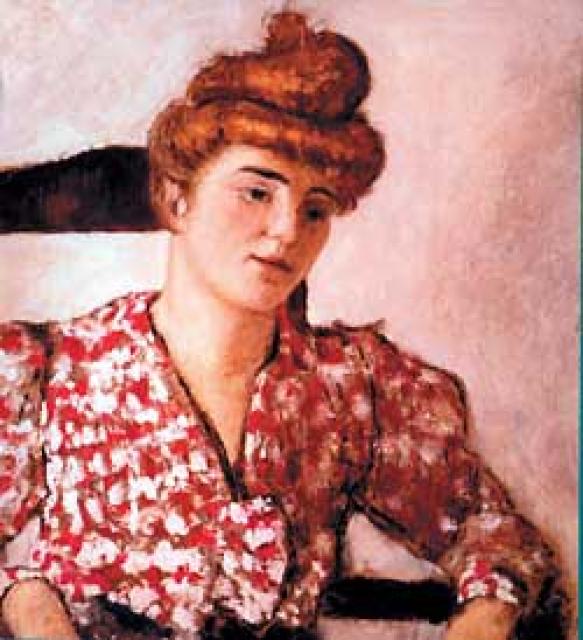
One of Misia's notable encounters was when Pierre-Auguste Renoir personally came to her apartment on Rue de Rivoli to paint her portrait. Due to his arthritis, Renoir was almost paralyzed and required a special lift to enter her bedroom. Renoir would be rolled in on a wheelchair, his hand attached to a stick so he could paint. Interrupting his work, he would ask Misia to "partially uncover her beautiful breasts," saying, "You should not hide what nature has given you." In gratitude for the portrait, Misia sent Renoir a blank check, allowing him to write any amount. Renoir valued his work at 10,000 francs.
Misia's husband, Alfred Edwards, became more interested in the theater than in her. He wrote a play called "The Lost Parrot" for actress Lantelme, whom he fell in love with. In an attempt to persuade Lantelme to become his mistress, Edwards sent Misia to her. Lantelme agreed, but after a day, she changed her mind and agreed to pursue a relationship with Edwards. Misia took her husband's infidelity calmly because she was already involved with the Spanish artist Jose-Maria Sert, whom she would soon marry.
Relationship with Sergei Diaghilev
In 1908, Misia met Sergei Diaghilev during the premiere of "Boris Godunov" at the Paris Opera. The performance deeply moved her, and she bought all the unsold tickets to make it seem like a financial success. This act prompted Diaghilev to return to Paris. Their friendship lasted for over 20 years, and Diaghilev considered Misia to be the only woman he could marry. Misia knew all the intricacies of Diaghilev's personal life. In 1913, while in Venice, she witnessed his reaction upon learning about Vaslav Nijinsky's marriage to Romola de Pulszky.
Diaghilev invited Misia to hear Rossini's "La Boutique Fantasque." Misia arrived with an umbrella, which Diaghilev repeatedly opened and closed during her performance. After finishing, she asked Diaghilev to leave the umbrella alone, saying, "Don't you know it is a bad omen to open an umbrella indoors?" At that moment, a knock at the door announced the telegram about Nijinsky's marriage. Shortly after, all the furniture in the hotel room was destroyed. Only Misia managed to calm down the enraged Diaghilev, whom his friends referred to as "Diagh."
Misia's wealth often saved the "Russian Seasons" from imminent financial collapse. It was thanks to the 4,000 francs she gave Diaghilev that the premiere of the ballet "Petrouchka" took place. Without her support, the staff of the Paris Opera refused to provide costumes to the Russian dancers.
Diaghilev's friends often complained to Misia about his stinginess. Lev Bakst exclaimed, "This dirty exploiter," and Igor Stravinsky echoed, "He is a pig and a thief." Sergei Pavlovich also vented his grievances to Misia, saying, "I found out that my firstborn, Igor Stravinsky, has devoted himself to the double service of God and money."
Misia listened to everyone, sympathized with everyone, and paid for everything. Her own funds covered Diaghilev's funeral expenses. In 1929, feeling that something was wrong, Misia, accompanied by Coco Chanel, traveled to Venice. She visited Diaghilev and found him on his deathbed. His last words to her were, "Misia, you look good in white. Only wear white."
Misia paid for his funeral as requested and fulfilled his last wish by dressing in white for the ceremony. Coco Chanel, with whom she had been close friends for thirty years, bid her farewell. In Misia's memoirs, Chanel's name is never mentioned, as it was Chanel's wish. Misia told her, "I will write about myself, and you don't need to write anything. Just publish your accounting books."
Despite their sharp exchanges, Chanel and Sert remained closest friends until the end. Misia helped Chanel heal her emotional wounds after unsuccessful romances, and Chanel came to Misia's aid when her beloved Jose-Maria became infatuated with Georgian artist Rusi Mdivani and asked Misia for a divorce.
Sert not only agreed to the divorce but also helped Jose-Maria choose an engagement ring for Rusi. She never left the young couple alone, thus fueling rumors of a "trio." However, there was no real basis for these rumors. Misia, equally in love with both Rusi and Jose-Maria, described herself as feeling like "either a mother-in-law or a stepmother."
When Jose-Maria Sert passed away, Misia wrote in her diary, "With him, all sense of existence disappeared for me." As a result of the shock she experienced, she almost completely lost her eyesight. Shortly before she went completely blind, Misia made her final trip to Venice, where she bid farewell to her beloved paintings in the Academy Gallery, verbally describing them from memory.
Towards the end of her life, Misia found solace in morphine. She openly consumed drugs, injecting herself with them on the streets. Once, she spent a day in a police station alongside prostitutes and vagrants after her name was found on a list of drug dealers.
She passed away in 1950. Coco Chanel tried to lift her out of depression by taking her to a sanatorium in Switzerland. However, it was too late. At the age of 78, Misia died. Shortly before her death, she confessed to Chanel, "You know, life is not that beautiful after all."