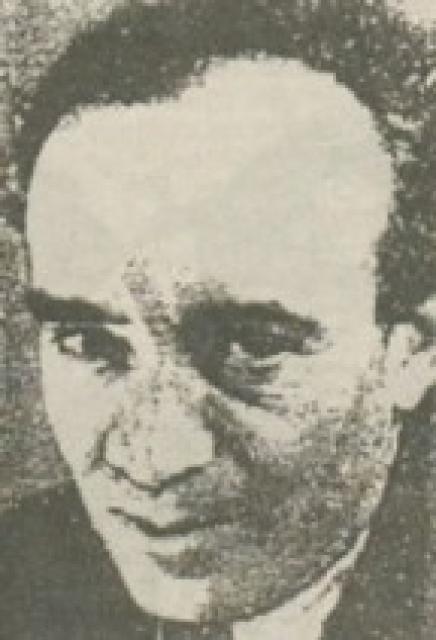
Moisey Goldblat
 Israel
Moshe Goldblat: A Biography
Moshe Goldblat was an actor and director of Jewish, Russian, and Romani theaters. He was the creator and first artistic director of the Moscow Romani Theater "Romen". Goldblat was awarded the title of Honored Artist of the Russian Soviet Federative Socialist Republic (RSFSR) in 1935, People's Artist of the Kazakh Soviet Socialist Republic (KSSR) in 1943, and Merited Artist of the Ukrainian Soviet Socialist Republic (USSR) in 1945.
Although most sources note that Moshe Goldblat was born in Bessarabia, it is highly likely that he was actually born in the northern Moldavian town of Hertsa (now part of the Hertsaivka district of Chernivtsi Oblast, Ukraine). He probably grew up in the neighboring Bessarabian Governorate. As a teenager, he joined a traveling Jewish theater troupe and performed in a Jewish traveling theater from 1918 to 1921, touring various towns in Ukraine.
In 1924, Goldblat graduated from the theater studio at the Moscow State Jewish Theater (GOSET) under the guidance of Alexey Granovsky. He had been a member of the main acting ensemble of the theater since 1923. In 1925, he appeared in one of the leading roles in the film "Jewish Happiness", directed by A.M. Granovsky and based on the works of Sholem Aleichem. Until 1937, Goldblat worked at GOSET and taught stagecraft at the Moscow State Jewish Theater School (MGETU) affiliated with the theater. He was one of the leading actors during the theater's heyday in the late 1920s and early 1930s, under the leadership of Solomon Mikhoels.
Simultaneously, in accordance with the Soviet Union's policy of promoting the culture of national minorities, Goldblat became the director of a amateur troupe of aspiring Romani artists in 1929. With the support of the People's Commissar of Education Anatoly Lunacharsky, on January 24, 1931, Goldblat founded and led the theater studio "Indo-romen" at the State Institute of Arts of the RSFSR. On December 16 of the same year, the studio acquired the status of a professional collective. Alexander Tyshler, the set designer of the Moscow GOSET, was appointed as the theater's art designer, while folklorist and composer S.M. Bugachevsky became the musical director. Ivan Rom-Lebedev was in charge of the literary department, and the veteran Jewish actor I.D. Fail served as the administrator.
Moshe Goldblat was the artistic director and main director of the "Indo-romen" theater studio (also known as the indoromen theater-studio) until 1936. The performances during these years were conducted in the Romani language, starting with the inaugural production on April 30, 1931 – a review of Romani Soviet life titled "Atasya i dadyves" (Yesterday and Today), written by E. Sholokh and M. Bezyudsky. Goldblat also directed plays such as "Life on Wheels" by A.V. Hermano (1931), "Pharaoh's Tribe" by Sverchkov based on the stories of A.I. Kuprin (1933), "Between the Flames" by A.V. Hermano (1934), an adaptation of Prosper Merimee's novella "Carmen", and plays by I.I. Rom-Lebedev such as "Camp in the Steppe" (1934), "Steppe Daughter" (1935), and "Wedding in the Camp" (1935). Goldblat's final work in the indoromen theater was the staging of Alexander Pushkin's poem "Gypsies" (1936) with music by Alexander Krein and set design by A. Tyshler. In 1935, together with Evgeny Schneider, Goldblat directed the film "The Last Camp" starring Nikolai Mordvinov, Mikhail Yanshin, and artists from the "Indo-romen" theater, including the renowned romances singer Lala Chernaya (Nadezhda Kiseleva).
After Goldblat's departure, the "Indo-romen" theater was led by M.M. Yanshin, and the theater's work was translated into Russian. From 1937 to 1939, Moshe Goldblat served as the artistic director of the newly established Birobidzhan State Jewish Theater (BirGOSET), where he focused on serious dramatic material as a director. He staged plays such as Moyshe Kulbak's "Boytre-gazlen" (Yiddish: The Bandit Boytre) and "Binyomen Magidov" (both in 1937), which the theater had to stop due to the arrest of the playwright. In 1938-1939, Goldblat also directed "Tevye Der Milkher" (Tevye the Dairyman) and "Menchn" (People) based on the works of Sholem Aleichem, as well as K. Gutsman's play "Uriel Acosta". Well-known Moscow artists and composers were involved in the production design of these plays.
In late 1939, Goldblat became the head of the Kiev State Jewish Theater (GOSET), located at 29 Khreshchatyk Street. The first production on the new stage was the historical tragedy "Bar-Kokhba" based on a play by Avrum Goldfaden (set design by Nathan Altman). In the play "Der Farkishefter Shneider" (The Enchanted Tailor, set design by Nathan Altman, 1940), based on Sholem Aleichem's work, Goldblat served as both director and lead actor, playing the main role of the tailor Shimen-Ele. He also directed plays such as "The Ten Commandments," "Afn Boydem A Yard" (A Fair in the Attic, or An Ordinary Miracle), "Kol Nidre" (Memorial Prayer) by Peretz Markish, "Vartožiti na sviti" by A. Guberman, and others. Goldblat himself wrote the music and lyrics for the songs in these productions. With the outbreak of World War II, the theater was evacuated to Dzhambul (later to Kokand and Fergana), and Goldblat was appointed as the artistic director of the Kazakh State Drama Theater (1941-1944) in Alma-Ata. In 1942, he appeared in the short film "Priceless Head" directed by Boris Barnet (role of an unnamed Jew) in War Newsreel No. 10 (TsOKS Studio, Alma-Ata). After the end of the war in Ukraine, the Kiev GOSET was transferred to Chernivtsi, and Goldblat remained its artistic director until the theater, along with all the Jewish theaters in the country, was closed during the fight against rootless cosmopolitans on February 15, 1950.
On March 10, 1945, the first season of the theater (now named after Sholem Aleichem) in Chernivtsi began with a new production of Moses Pinchevsky's play "Ikh Lab..." (I Live..., with Goldblat in the lead role of Tzale Shafira). However, the play received criticism in the press for its nationalist motives, pessimism, lack of ideological content, and decadence. Goldblat had previously directed a production of this play while in evacuation in Kazakhstan. Another success of the post-war period for the Kiev GOSET was the staging of Sholem Aleichem's "Tevye the Dairyman", with Moshe Goldblat playing the role of Tevye. The theater also performed "Blondzhende Shtern" (Wandering Stars), also by Sholem Aleichem, which portrayed the fate of the first stars of contemporary Jewish theater. In its final year of existence (1949), the theater presented 13 premieres. In the late 1940s, Goldblat was investigated as part of the Jewish Anti-Fascist Committee, but he was not arrested. From 1951 to 1959, he served as the artistic director of the Kazakh State Academic Drama Theater (now named after Mukhtar Auezov) and simultaneously worked as a director and stage director at the State Russian Academic Drama Theater named after Lermontov in Alma-Ata. He continued to work as an actor at the Kharkov Russian Drama Theater until 1969.
Goldblat wrote memoirs about actors Les Kurbas and Solomon Mikhoels (1969), as well as later unpublished memoirs about Mikhoels and Veniamin Zuskin (1974). He compiled a review of the history of Soviet Jewish theater in Yiddish titled "Der ufkm un umkum fun der idisher teater-kultur in sovetn-farband" (Rise and Fall of Jewish Theatrical Culture in the Soviet Union), which is held in his archive at the Institute of Diaspora in Israel. From 1972, Goldblat lived in Israel and settled in Haifa.