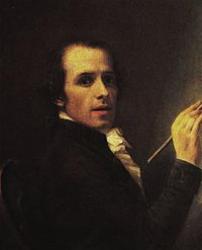
Moissey Kogan
 France
- Biography of Moisei Kogan
- Education and Early Career
- Artistic Successes and Patronage
- Artistic Style and Exhibitions
- Later Years and Legacy
Biography of Moisei Kogan
Moisei Kogan was a French sculptor and graphic artist. He was born in the town of Orgeev, Bessarabia (now part of Moldova), into a religious Jewish family. After attending a heder, his family moved to Kishinev, where he completed his secondary education. In 1897, Kogan began studying chemistry in Odessa, and in 1903, he followed his older brother to Munich, where he joined a community of Russian artists led by Wassily Kandinsky and Alexej von Jawlensky.
Education and Early Career
In Munich, Kogan and his brother enrolled in the Academy of Fine Arts, where he studied medal art, pottery, wood and stone carving. He earned a living by creating drawings for embroidery and textiles. In 1908, three of Kogan's bronze reliefs were exhibited at the joint exhibition of the Berlin and Munich Secessionist movements, attracting the attention of Auguste Rodin, Aristide Maillol, Adolf von Hildebrand, and the critic Julius Meier-Graefe. During this time, Kogan developed a close friendship with the dancer Alexander Sakharov.
Artistic Successes and Patronage
Following his participation in the Berlin Secession in 1909, Kogan became affiliated with the "New Association of Artists" organized by Kandinsky, and later joined the "Blue Rider" group in 1911. In 1909 and 1911, his works were exhibited at the First and Second Salons of V.A. Izdebsky. He taught at the Hamburg School of Arts and Crafts before settling in Hagen at the recommendation of his patron, Karl Ernst Osthaus. However, plans for a studio funded by Osthaus fell through, and in 1910, Kogan moved to Paris, where he rented a studio in the famous "Hive" building.
Artistic Style and Exhibitions
In Paris, Kogan primarily focused on sculpture, creating female nude figures and torsos in wood and terracotta, as well as bronze statuettes. He also worked on engravings on wood and linoleum, and lithography. His works were exhibited in solo and group exhibitions in Munich, Weimar, Cologne, Hagen, Dresden, and the Berlin Secession. In 1914, Kogan decorated the walls of the German Industrial Exhibition building with reliefs. During World War I, he spent 1915 in Switzerland, where he developed and refined his own negative sculpture technique.
Later Years and Legacy
In 1922, the Berlin gallery of Alfred Flechtheim published a series of wood engravings by Kogan, illustrating the poem "Jizo" by his friend, writer and art critic Karl Witte. In the 1920s, Kogan mentored the sculptor Arno Breker, who created portraits of him in both sculpture and graphic art. In the 1930s, Kogan taught at the New School of Arts of Paul Citroen in Amsterdam. Tragically, in February 1942, Kogan was captured by Vichy authorities and sent to the Drancy camp, where he was immediately killed in the gas chamber at Auschwitz.
Moisei Kogan's first posthumous exhibition was organized by renowned art historian John Rewald in 1955. Since then, several other solo exhibitions have been held, including one in 1964 in Düsseldorf and a centennial exhibition in the Netherlands in 1979.
Moisei Kogan's brother, Shneur Herzovich Kogan (1875-1940), was a Bessarabian Romanian artist and the founder and professor of the Kishinev School of painting, which later became the Higher School of Fine Arts.