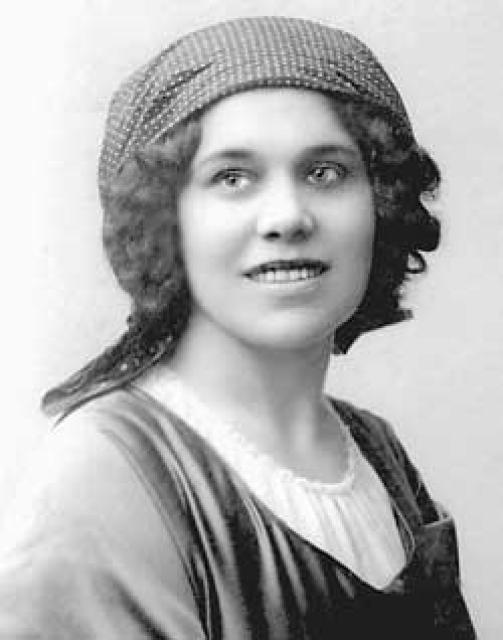
Nadejda Plevitskay
 Russia
Biography of Nadezhda Plevitskaya
Nadezhda Plevitskaya was a Russian singer and performer of Russian folk songs and romances. She was born as Nadya Vinnikova in 1884 in the village of Vinnikovo near Kursk. Her family was hardworking and religious. Despite only completing two and a half years of primary school and spending two years as a novice in a monastery choir, Nadya, nicknamed Dezhka, had a natural talent for singing. She became a soloist in a professional touring choir at a young age, despite not knowing how to read music.
During her travels, Dezhka met Polish dancer Edmund Plevitski. They initially worked together in the same program and eventually got married in 1903. One day, while performing at a restaurant during the Nizhny Novgorod Fair, they caught the attention of renowned opera singer Leonid Sobinov. Sobinov was so moved by Dezhka's performance that he approached her backstage and praised her talent. He immediately invited her to participate in a charity concert with famous Russian artists Vasily Kachalov and Matilda Kshesinskaya, which took place in the city opera house. Plevitskaya exceeded Sobinov's expectations and performed brilliantly alongside the Imperial Theater artists.
In 1910, she gained widespread recognition when she performed in front of Tsar Nicholas II, who called her "our Kursk nightingale" and presented her with a precious brooch. Plevitskaya's fame continued to grow, and she garnered praise from the Russian press. Her performances were not limited to the Russian Empire; she also received acclaim abroad.
In the same year, Plevitskaya had a memorable encounter with renowned opera singer Fyodor Chaliapin. Chaliapin affectionately embraced her and referred to her as "dear Nadyusha." They shared a warm moment before parting ways.
Plevitskaya's songs resonated deeply with the national consciousness and emotions. Critics praised her for evoking more sentiment and national pride than the nationalist voices of her time combined. She also starred in movies such as "The Power of Darkness" and "The Cry of Life," solidifying her status as a beloved Russian performer. Her talent captivated audiences from all walks of life, including aristocratic salons and intimate amateur theater gatherings.
During World War I, Plevitskaya accompanied her husband, Lieutenant Shangin, to the frontlines as a nurse. However, tragedy struck when Shangin died heroically in battle in January 1915. Shortly after, Plevitskaya found solace in another lieutenant, Yuri Levitsky, whom she married. When the Russian Civil War broke out, they decided to leave Russia and joined the White Army in their evacuation to Turkey in 1921. In Gallipoli, they got married.
In the early 1920s, Plevitskaya embarked on successful concert tours across Europe, performing for Russian expatriates in Germany, Yugoslavia, Romania, Bulgaria, and France. Despite her talent, she struggled to achieve international stardom as her repertoire of Russian folk songs and romances appealed primarily to impoverished emigrants and did not resonate strongly with European audiences.
Financially, life became easier for Plevitskaya and her husband in the mid-1930s. They were able to afford luxuries such as a car and expensive sanatorium treatments. Rumors circulated among the emigrant community in France that she received money from the Soviet secret police, but the court of honor dismissed these allegations due to a lack of evidence.
In reality, it was revealed later that General Skoblin, Plevitskaya's husband, had been recruited by the Soviet secret police in 1930. Plevitskaya was also recruited as an agent. They received code names "Farmer" and "Farmer's Wife" and a substantial salary of two hundred dollars. They dutifully provided valuable information about the Russian All-Military Union and the lives of the White emigration. Their espionage career reached its peak when Skoblin successfully kidnapped General Miller, the chairman of the Russian All-Military Union, in Paris. Skoblin managed to escape the two elderly and foolish generals who had attempted to apprehend him and took refuge in the GPU safe house on the floor above the Union headquarters. Later, he was sent to war-torn Spain, where he died under mysterious circumstances in 1938.
Plevitskaya, however, denied any involvement in espionage during her trial and maintained her innocence. Despite the lack of direct evidence against her, she was sentenced to 20 years of hard labor. She died in the autumn of 1940 in a women's prison in Rennes, at a time when Europe was engulfed in bloodshed and her talent as one of the most gifted Russian singers of the 20th century went unnoticed.


