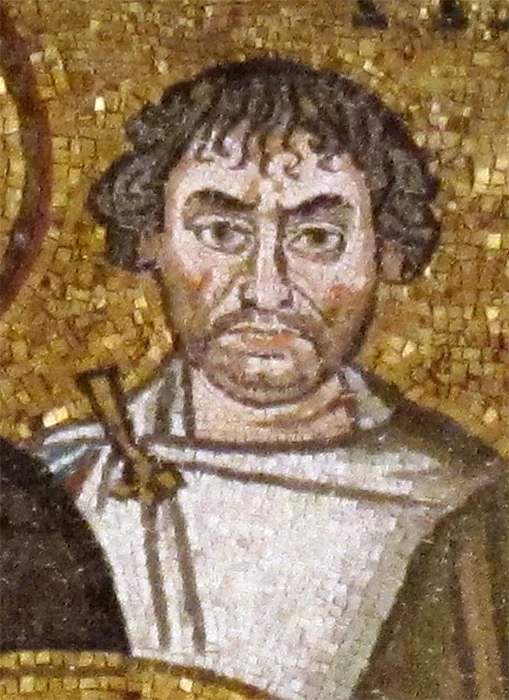
Narses
- From court official to commander
- The Italian campaigns
- Governor of Italy
- Recall and later stories
- Legacy
Narses rose from the Byzantine imperial court to become one of the most consequential generals of Justinian I’s reign. A eunuch official of Armenian background, he was entrusted with the campaign that finally broke the power of the Ostrogoths in Italy. His victories reshaped the balance of power in the Mediterranean, though the long wars left the peninsula exhausted and difficult to govern.
From court official to commander
Narses’ early life is poorly documented. He was probably born in the late fifth century and came from an Armenian family. As a eunuch, he was able to hold senior positions within the imperial household, where he built a reputation for intelligence, discretion, and political skill. He became a trusted official of Emperor Justinian and rose to the influential position of grand chamberlain.
In 532, during the Nika revolt in Constantinople, Narses helped the government regain control. According to later accounts, he used the imperial treasury to win over members of the Blue faction, one of the groups involved in the unrest. The revolt was then suppressed by force. His role demonstrated that his strengths extended beyond administration and court politics.
The Italian campaigns
Justinian’s ambition to restore Roman control in the western Mediterranean led to a long war against the Ostrogothic kingdom in Italy. Narses first served in the campaign as a senior official and commander, but tensions with the more experienced general Belisarius complicated cooperation among Byzantine leaders. Narses was recalled from Italy in 539.
The war dragged on, and in 551 Justinian appointed Narses to lead a new expedition. He assembled a diverse force drawn from across the empire and advanced into Italy. In 552, at the Battle of Busta Gallorum, also known as the Battle of Taginae, Narses defeated the Ostrogothic king Totila, who was mortally wounded. The victory was a decisive turning point.
The Goths continued to resist under their new king, Teia. Narses defeated his forces at Mons Lactarius in 553, effectively ending organized Ostrogothic resistance. He then fought Frankish and Alamannic forces that had entered Italy, defeating them near the Volturnus River in 554. These victories restored imperial rule over much of Italy, though they came after years of destructive fighting.
Governor of Italy
After the campaigns, Narses remained in Italy as the emperor’s leading representative. Governing from Ravenna, he supervised military and administrative affairs and worked to restore imperial control. His authority was extensive, and he continued to manage the region until the political climate shifted after Justinian’s death in 565.
The reconquest had secured Justinian’s claim to Italy, but the peninsula had been ravaged by decades of war. Its cities, farms, and population had suffered, and imperial control remained vulnerable. Narses’ military success could not easily reverse those costs.
Recall and later stories
Justinian’s successor, Justin II, eventually recalled Narses from Italy. Later western accounts tell a famous story that Empress Sophia insulted him by suggesting he return to spinning wool with the women of the palace, prompting him to invite the Lombards into Italy. Historians treat the tale with caution: it was recorded long after the events and appears to be a legend explaining the Lombard invasion rather than reliable evidence of Narses’ actions.
The details of Narses’ final years are uncertain. He died around 573 or 574, having spent much of his career in imperial service.
Legacy
Narses is remembered as a gifted strategist and administrator whose campaigns changed the course of sixth-century Italy. His victories over the Ostrogoths secured one of Justinian’s greatest conquests and demonstrated that military command in Byzantium could be held by a court eunuch as well as by a conventional aristocratic general.
His career also reveals the limits of reconquest. Winning territory was only the beginning; the wars left the restored provinces weakened, and imperial rule in Italy would soon face new challengers. Narses’ name endures both for the skill with which he commanded armies and for the difficult legacy of the world his victories helped create.